
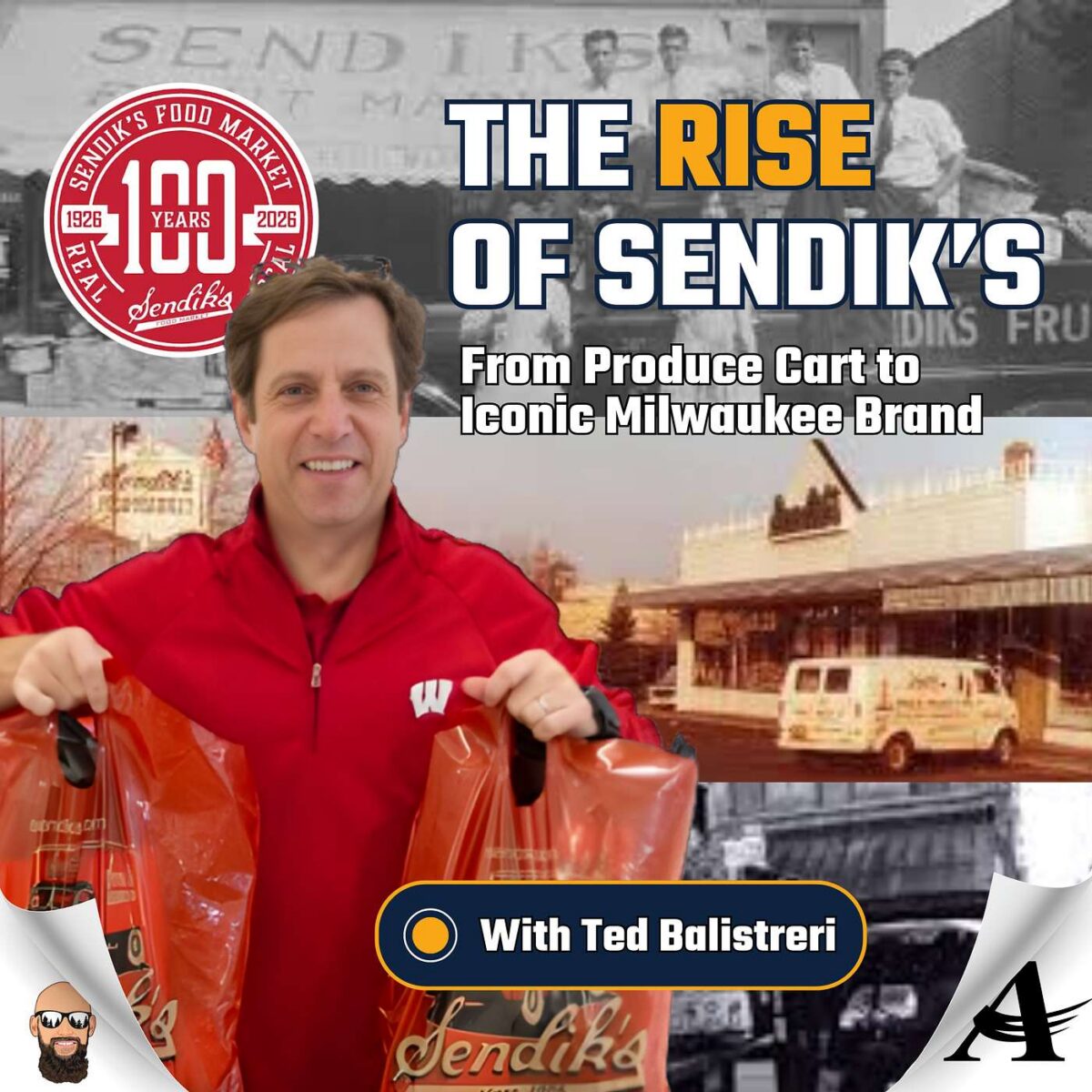
How did a business go from a produce cart to an iconic Milwaukee area brand with 17 locations that donates hundreds of thousands of dollars a year to charity?
Today we sat down with co-Owner and third generation family member Ted Balistreri to go over:
- Sendik’s backstory
- Ted’s early days at Sendik’s
- Expansion in the 70s
- Biggest obstacles
- Continued growth
- Building culture
- Why local
- The legend of Pappa Fallucca
- How to spend $50 on a meal for your family
- New Whitefish Bay store
SPEAKER_00
0:00
Well, when you have a history of over you know, a hundred years, you have to deal with a lot of different things, depressions, uh, recessions, uh, pandemics, uh wars, all those things. I think the constant is they were very true to what their founding principles were, which was high quality of products, um, and a high level of service. So those have really been, you know, the cornerstones of what they wanted to deliver to the to the marketplace.
SPEAKER_01
0:28
Hey everyone, welcome back to Milwaukee Uncut. Today we've got an incredible Milwaukee area story of how an Italian immigrant's produce cart turned in to your favorite local grocery chain with 17 locations that gives back hundreds of thousands of dollars a year to local charities. If you guessed it, it is the story of Sendex. The company turns 100 this year, and we are joined by one of the owners and third generation family member, Ted Ballistrari, who is awesome to meet and have on, super nice guy, and has some amazing stories and takes you inside of growing an iconic local brand. If you love Milwaukee, if you love a good business story, this is a great one for you. Personally, this was cool for me as Brian and I swing by their north level location um at least five times a week. Big fan of that place since we moved over to Toassa. They do a phenomenal job, and it was awesome talking to Ted on this episode before diving in. I want to thank our partners who make Milwaukee Uncut possible. Nikolila, the Midwest Law from Injured. Get Nikola and Russ and the team will take great care of you. That is Nikolala, Drink Wisconsin Bleed Beverage Company, best vodka brandy and canned cocktails in the game available at bars and liquor stores across the state. At the Drink Wisconsin Blee pub right across from the Fiserve, they've got their corner bar in Rightfield at MFM right now. And I see their candle fashions, my favorite at Sendex. You can pick them up there. And if you're if you're looking for beer, Sendex also has a great selection of our friends over at ThreeSheaps. And last but not least, our friends over at NX Wealth Management. If you're looking to get your finances together this year and have a goal that deals with your money, your earnings, your investments, go talk to the experts at NX. They have an amazing team ready to listen and help you with your personal goals. NXWealth Management, know the difference. Just head on over to NXWealth.com. Alright, let's dive in with Ted Ballastard. Hey everyone, welcome back to Milwaukee Uncut, the iconic locally owned grocery chain. Sendex is celebrating its 100th anniversary this year. Sendex currently has 17 locations in the area, and they will be adding or replacing, renovating, upgrading their store in Whitefish Bay to State-of-the-art store this year. They also love to give back. They've donated over$4.5 million to local organizations over the last 12 years. Third generation owner Ted Ballastruri is with me. He's actually a former lawyer who's been with the company since 2001, I'm sure growing up as well. We'll we'll we'll get into that. And um in a lead athlete, I heard you ran at the University of Wisconsin for four years and have run several marathons. Thank you for being here. Thank you for providing Brianna with uh lunch and dinner about five, six times a week from your North Av location. We are excited to have you on.
SPEAKER_00
3:26
Well, thank you. It's great to be here. Yes.
SPEAKER_01
3:28
Um we don't have to talk about your run running from us, but um I don't know where you dug that up as that that's ancient. I had an inside source. That is impressive though. Um how many marathons have you run?
SPEAKER_00
3:42
I've run 12 marathons and one ultra. Ultra being a 50. You did an ultra.
SPEAKER_01
3:48
Yeah. Where where and when was it?
SPEAKER_00
3:50
I did the uh Ice Age 50, which is uh an incredible event um right here on the Ice Age Trail.
SPEAKER_01
3:59
50 miles. What time did you clock for 50?
SPEAKER_00
4:03
I did it in a little over 11 hours. That's pretty good.
SPEAKER_01
4:07
Yeah, yeah. That's about um Yeah, I I I have one marathon to my name. I was one and retired. I I did break five hours. Yeah. Not by much. Um, my dad's done a bunch of marathons. He's actually done a couple Ironmans and really wanted to run one with me. So I'd this was why this was in like 2010. Uh like had a couple drinks on New Year's and and eagerly agreed to do one with him.
SPEAKER_00
4:31
And that's usually the way it happens. So you get challenged and uh your bravado sets in, and yep, I can do this.
SPEAKER_01
4:38
Yeah, trained quite a bit for it, actually. And then I remember we got to mile 13. I I grabbed him, I'm like, I can't move. He's like, what do you mean you can't move with with a few more expletives in that sentence? And I was like, I can't move. And then it was uh a walk limp sprint in the street.
SPEAKER_00
4:53
Death marks uh the rest of the way, yeah.
SPEAKER_01
4:56
Very impressed that you've knocked 12 out as well as well as uh well as an ultra.
SPEAKER_00
5:00
You know, it's uh I enjoy it, it's kind of therapy for me. So I like I like the training. It's nice, it is a great way to get out and uh Yeah, I love being outside, I love being in nature. I'm one of those people, I rarely uh run with any music or anything like that. I just like to let my mind go, and it's a source of creativity and a lot of fun. And uh there's also a lot of camaraderie. I have a good friend of mine that I've been running with for over 20 years. We meet every uh Wednesday morning at 5 30 in the morning and knock off a few miles, and it's always a a good time.
SPEAKER_01
5:37
I'm assuming that friend is not TJ Marini.
SPEAKER_00
5:40
No, it's not.
SPEAKER_01
5:40
No, no, definitely not. What what is what is the favorite location you've run a marathon in before, favorite route?
SPEAKER_00
5:47
Well, I've run Boston uh six times, which is really an exceptional thing, and uh the uh it's an exceptional race, and I happen to be there unfortunately for I was there in 2013 when uh the bombing occurred. Um and that was really a moving experience. Um and so because of that, I ended up going the next year uh just to kind of uh give my support to the event. Uh-huh. So that was 2014, and then a friend of mine qualified for 20 uh 15, so I went out there and ran it with him, and then we both qualified again, so ran it a a fourth time. And then I thought, well, what the hell? Might as well do it a fifth time. Five in a row would be kind of cool. So uh Boston is amazing, it's amazing. Uh it's an amazing scene. It's you know, 30 to 35,000 participants, uh fans lining both sides of the street most of the way. Um it's there's it's just really a special event.
SPEAKER_01
6:49
Well what was it like in 2013? Where where were you when the bombing had happened? Were you?
SPEAKER_00
6:54
Yeah, so 2013 I was actually through the finish line and and when I found out about it, I was actually back at my hotel. Um but my concern was that I had a friend out on the course and uh then it was trying to find him and um uh making sure that he was safe. So um yeah, uh really uh an uh uh a terrible uh event and and as you can imagine very emotional because uh once you've gone through run 26 miles, you're physically absolutely drained. And uh so the emotions are are very uh prominent and so very emotional. Uh being back in 2014 was incredible. Um the amount of fan support was unbelievable, uh really, really was special, and of course, uh many of the injured victims were there. Uh was really uh kind of an exceptional experience.
SPEAKER_01
7:49
That your best running experience going back in in 2014 and being part of that scene and that energy.
SPEAKER_00
7:57
I think being part of that community, uh the Boston community, the running community that was uh you know so uh taken back by what had happened uh the year before and the support that was shown, the love, uh it was it was pretty moving. Yeah.
SPEAKER_01
8:14
Before we move on to uh your your com your company story, I got if you're qualifying for Boston, you're you're moving at a pretty good clip. What's your fastest marathon time?
SPEAKER_00
8:23
Um I've been under three hours uh under three many uh several times. Uh uh now I'm uh you know I enjoy it. You know, I've a I've adopted the Jeff Galloway. I mean, may he just recently passed away, but he was a famous runner who um coined the the the or or invented a a way of running a marathon, which is uh called the Galloway method, where you run a mile and then you walk for a minute. And you you do that. And I did that the last marathon I ran, which was the the Green Bay Marathon. Um and it it was so pleasant, it was great. So I'd like to do that. And my goal now is to break four hours, not three.
SPEAKER_01
9:03
All right. All right. Four hours with 25 minutes, 26 minutes walking is yeah, that's but you know what I found is that you recover so quickly from it.
SPEAKER_00
9:13
But secretly, I have this goal that I would love to try to get to Boston one more time. I think it would be really fun.
SPEAKER_01
9:19
What do you have to do to do that these days?
SPEAKER_00
9:21
I'm not sure what the with the uh with the age. I think I'm with my age, I might be in the 340 range, something like that. Okay. Um so I think it's doable, but I don't know if I want to work that hard. But uh, you know, it's uh it's a great event.
SPEAKER_01
9:40
Um yeah, so so Sendex uh iconic Milwaukee brand, really interesting backstory. Can you tell us how how it all began?
SPEAKER_00
9:51
Sure. Well, um my great-grandfather, uh you know, he he well, first of all, uh the family immigrated from Sicily. And it was really my great-grandfather uh started traveling to the United States in the 1880s, 1890s. And uh he went back and forth uh quite a bit. And uh eventually he met my great-grandmother and they started a family, and and uh an interesting thing about it is they actually started their family here in Milwaukee, but then they made the decision that they wanted to raise their kids back in Sicily, so they moved uh the family back to Sicily, and my my grandfather was actually born in Sicily. Um but because my grandfather had uh he had a dual citizenship, he was in a uh had American citizenship, uh my grandfather when he was born had American citizenship at the time.
SPEAKER_01
10:44
So that was around 1900. Yeah, yeah, he was how rare was that in those days.
SPEAKER_00
10:48
Yeah, I don't know, I don't know how rare it was. I don't think it was rare for people to make the trip back and forth.
SPEAKER_01
10:53
Okay.
SPEAKER_00
10:54
Uh especially uh in the Italian community, the Sicilian community. That was not unusual for them to make that back and forth trip. In fact, a lot of them would come and work here in the summer, uh, make money, and then head back and spend their winters in Sicily. So and then um in 1926, uh my grandfather, around 1926, my grandfather uh he was seven he was gonna be seventeen. I think he was seventeen at the time. And uh the family then made the definitive decision to move uh uh everybody over to the United States, largely because if they had stayed, my grandfather would have been conscripted into the army uh in st in Italy and they they didn't want to do that. So they moved here uh 1926. My great-grandfather had been uh selling produce wholesale uh in the third ward, and uh my grandfather and his brothers uh started uh it you know decided to have their first store which they opened in Shorewood and uh st just a fruit and vegetable market.
SPEAKER_01
12:01
And then uh how is it for them getting getting it off the ground? What were the early obstacles like the depression hit shortly after that, obviously?
SPEAKER_00
12:10
Yeah, absolutely. And well, when you have a history of over you know a hundred years, you have to deal with a lot of different things depressions, uh recessions, uh pandemics, uh wars, all those things. I think the constant is they were very true to what their founding principles were, which was high quality of products um and a high level of service. So those have really been you know the cornerstones of what they wanted to deliver to the to the marketplace. And I would say that they combined it with a a really um high-level work ethic. Um my grandfather, my father, uh just really hard-working people, um, you know, didn't matter what time of the day or night they were if if they could uh if there was a market open somewhere they were trying to buy produce uh at that market and bringing it to the stores.
SPEAKER_01
13:05
And uh how did Sundex transition from the produce stands, few produce stands, to uh kind of the modern day supermarkets and what was that expansion like?
SPEAKER_00
13:15
Yeah, it was that happened in the 1970s, and what happened was um uh my grandfather and his brothers, and he had uh four brothers, um, one of whom was not in the business, but uh four of them were. Uh they ended up uh operating three different stores, one in Shorewood, that was the original store. Um and uh there was a period of time where they were um they they had to move locations in Shorewood. And so they opened a store on Downer Avenue during that period of time uh to while they were waiting for the new store to be ready. And that was their second store. Um and then uh it did so well that they decided to keep it open when when the new space was open in Shorewood. And then years later, my grandfather actually bought the property in Whitefish Bay and the brothers owned the three stores together. But they decided uh for various reasons that it would be better if each brother kind of owned a store, and one brother uh I don't think was interested in so um each brother you know uh ended up owning a different store and uh my grandfather ended up with the whitefish based store. Um and then it was my dad and his brother uh years later uh in the 1970s that transitioned uh the business from a produce market to a full-line grocery.
SPEAKER_01
14:38
Then has it always been named Sendix? And can you can you tell us uh that story?
SPEAKER_00
14:43
Aaron Ross Powell Yeah, it's a great story. Um when my grandfather, my great-grandfather first came to the United States and they s kind of settled, he and his family and his family, which is probably some other cousins and whatnot, were settling in the third ward, uh they needed a stove for their home. So they went and uh they went to a Sears or some other place like that to buy a stove and they found one that they liked. And uh they said to the sales clerk, send it to us, send it. And the sales clerk misunderstood what they were saying and thought that they were saying that their name was Sendik. So they the the deliver the uh salesperson wrote Sendik as their name on the delivery slip, and the delivery people came down to the third ward looking for the Sendek family to deliver the stove to. And anyway, the neighbors, it was a very tight-knit community, everybody knew each other, the neighbors realized what was going on, and then they started to refer to my my great-grandfather and his clan as the Sendek family. And so when they opened their store in in the uh in the nine in 1926, they decided to name it Sendix.
SPEAKER_01
15:51
So so he he loved he loved that the joke was on him, but he just ran with it aside.
SPEAKER_00
15:55
Oh, yeah, absolutely, absolutely. You know, they were wonderful people. Uh, you know, they they had a great sense of life and uh great humor, and you know, so um good people.
SPEAKER_01
16:07
Yeah, so there's three three-ish stores in the in the 70s. Um you guys have clearly grown quite a bit since then. What was expansion like those next several decades?
SPEAKER_00
16:17
Yeah, so then in uh you know, in the 19 mid-1970s, my dad and his brother uh owned the Whitefish Bay location, and there was an AP grocery store right next to them. And AP decided to move uh they it was really interesting. My grandfather, when he when he bought the Whitefish Bay store, um rented the space, built the store and rented half of it to an AMP grocery store.
SPEAKER_01
16:44
And for those who don't know, AMP was the dominant player back then, correct?
SPEAKER_00
16:48
AMP was uh a huge national player at the time. And um they were uh a pioneer in the uh 1930s, 1940s, 1950s, and grew uh really really expanded. And I think you know their history probably dates back to the 1900s, early 1900s. Uh-huh. Um so anyway, they had a uh, you know, my I I think about this in the audacity of my grandfather at the time to be building this fruit and vegetable market and then have a competitor uh that he was leasing space to right next to him. Um but what happened was the AMP decided to move uh to a different location, and my father, this was in the mid-1970s, took over that space. There was a wall that divided the two spaces. My dad had that uh wall uh removed, and he was in the in the grocery business then.
SPEAKER_01
17:46
What were your personal earliest memories of of all this? Did you grow up working in the stores? What was your upbringing?
SPEAKER_00
17:52
Oh, sure. Yes. I remember it when it was just a fruit and vegetable market, and I I mean I it was, you know, as a as a little kid, it was very uh joyful because I'd go down there and see my dad and my grandfather uh working, and um, you know, uh it was just a it was a great time, you know. You could uh eat fruit and and things like that. And one of my favorite things to do was we had a a uh orange juice squeezing machine, and I used to uh operate that machine when I was a little boy. And uh we lived on in Fox Point, so a lot of times I'd ride my bike down there, work for a few hours. My dad would give me five bucks, and then I'd go to the um, you know, the candy store and buy some candy or something like that.
SPEAKER_01
18:35
How was the dynamic between your dad and your grandfather? Did they work well? Did that did they butt heads like a lot of uh first and second generation business owners? What was you know?
SPEAKER_00
18:46
I don't really recall that. I I always thought it was a really good working uh relationship, and I think the thing was is that they were both really hard workers. So uh and by the time you know I was a little kid, my my grandfather had was pretty much out. Uh he was he had pretty much retired. Um, but he would come in and work because he that was what he did. That was his that was like him playing golf. Uh he'd go to work, and uh, you know, he'd he was great. Uh I love spending time with my grandfather. He was such a character, he had such a great sense of humor. He was so much fun to be around. And uh he used to love uh the flower part of our business. And so I get in a van with him and we drive to different uh you know greenhouses around the area and he'd pick out flowers and it was just a lot of fun. Um and he knew all the customers, all the customers he knew he knew most of them by name. Uh it was a special time. Whitefish Bay is a pretty tight community. Um my dad knew everybody. Um, yeah, so it's pretty neat.
SPEAKER_01
19:50
And did you did you have different jobs in high school or did you work at the grocery stores, or what what did you do?
SPEAKER_00
19:55
Yeah, so in high school, um mostly produce, worked in the produce department, um, you know, stocking produce, um, you know, also, you know, bagging groceries, whatever, whatever needed to be done, we'd do. But uh my dad worked in produce. That was his, he loved produce, and uh so he had us all of us kids working in that department.
SPEAKER_01
20:17
So was it what was that like? Did you enjoy it? Did you want nothing to do with it?
SPEAKER_00
20:21
Was it uh you know, I don't know that I I had a choice. The uh I you know he I always you know you wouldn't get away with it now. I kind of think it's funny, but you know, he'd write a schedule and it was you know six days um from 5 30 in the morning till six thirty at night, and you you didn't question it. You just said, okay, dad, I'll see you. Um I'll be up uh to drive down to work with you. So that's that's kind of the way it worked.
SPEAKER_01
20:49
It's kind of like the the immigrant type store style story that you hear about.
SPEAKER_00
20:54
Yeah, yeah. And um, you know, I I don't know that it was I don't know that we knew any better. So when you say, Did I enjoy it or not enjoy it, it wasn't really a choice. Um yes, I enjoyed it. I I enjoyed there were so many characters uh in the business, and I used to love going with my dad down to the market where he would buy produce and um on Commission Row, which was Broadway, uh was just a beautiful um symphony of product coming in and out, and all these characters and trucks and forklifts, and um it was just really a a lively scene at uh fashion.
SPEAKER_01
21:34
So bro, Broadway in the Third Ward in the 70s is what you're referring to, which is not nothing like it is today down here. Yeah, totally different obviously. Yes. What other things were going on down there other than produce?
SPEAKER_00
21:46
Well, that's really the area that that's what really what I knew. I mean, obviously, it's changed so much. Uh it's much more upscale now. It was a little bit run down, probably at that period of time, and uh right now. It's a much more exciting place. But you know, the the produce uh vendors, the wholesalers would, you know, they basically took over the street. There was no, there weren't any restaurants or anything like that. But what was really fun is uh occasionally uh my dad used to go down to the Chicago market, um the uh South Street Market in Chicago, which was enormous. And I got to go down with him uh several times to do that, and that was fascinating. That was, you know, you'd get there at 2, 2.30 in the morning, and it was like this little city in this this big city, um, and there was so much activity and things going on, and it it was uh fascinating.
SPEAKER_01
22:46
So you guys are waking up at like midnight drive down.
SPEAKER_00
22:50
Waking up midnight, uh uh driving down. My dad uh you know drove the semi. He had a semi, he'd drive it. Um I'd sit next to him, try to stay asleep, try to stay awake. Um fascinating how much it's changed now.
SPEAKER_01
23:06
How many siblings did do you have?
SPEAKER_00
23:08
So I have two brothers and a sister.
SPEAKER_01
23:10
Okay. And you guys all kind of worked together in in the store growing up?
SPEAKER_00
23:14
Yes, absolutely. And we work together now. So yeah.
SPEAKER_01
23:18
Are all all four of you still involved in the business? We are, yes. Wow, that's really cool. Yeah. Did you have a desire to join the business after college while you were in there at all? You went to law school at Marquette, I believe, right? That's right. And then was a lawyer for a decade almost?
SPEAKER_00
23:35
Yes, that's right. Um so I think for uh my father, um, you know, one of the things I think is interesting about more of an immigrant uh uh household is they they always they they always think that it's better uh if you are in a profession. So my parents really stress education, and um uh my dad really encouraged me to get my law degree, and so I did that. And um it's kind of funny because you know, in his mind, you're dealing with a higher level of person, a more educated person. Um you're you're in a profession where people are more professional and everything like that. And uh what I realized really quickly after I joined the law profession is that they're they're just as degenerate as anybody else. Yeah. They just happen to be a little smarter and can get through school.
SPEAKER_01
24:29
Yeah, law, finance, maybe, yeah.
SPEAKER_00
24:31
Yeah, right, right. So they can put it this way, they can uh sit and read uh legal cases uh more than the average person. So yeah. And then uh so I I practiced law for about 10 years and then had the opportunity. Um my um my uncle, uh, who's my dad's partner in his family decided that they wanted to open a store in another location. And so my uncle ended up selling his half of the business to my brothers and I. And that happened in 2001. And when that was when that was happening, I got a call from my dad and said, Hey, I'd really like you to join the business and uh be part of it with your brothers. And I thought at that time, I mean I I really enjoyed practicing law. It was a I was I was w with a really nice uh group of people in a nice law firm. Um, but to have the opportunity to join an iconic business with a really neat brand, I thought, man, there's never going to be another opportunity uh quite like this. And so I really uh took the, you know, it took me about half a second to say, yes, dad, I'll join, I'll join the business. And so that was in 2001. And um we were later joined by our sister Margaret. It's Patrick and Nick are my brothers, and our sister Margaret joined us later.
SPEAKER_01
25:49
So what was it like working with your dad? I hear he's a legendary in in individual.
SPEAKER_00
25:55
Oh, in so many ways. Um, you know, he was just he was salt of the earth, um, hardworking, um honest, um, just a high level of integrity, um, really smart, knew how to uh read people, uh, was very understanding. Uh, he was a great mentor. You know, one of the great things, and I I had a really close relationship. We all had a close relationship with our parents, um, who we all enjoyed spending time with. Um, but you know, he was always, he always had some sage advice at the right time. But one of the things uh that he did when my brothers and I um started running the business in 2001 was that he really gave us breath. Um he could have been a real jerk. Uh he could have said, hey, you know what, this is my business, you're gonna do it my way. He didn't do any of that. He said, look at you guys got to run this now. And he gave us the freedom to do it and to make our own mistakes. Um, which, you know, if you're in business, uh, you know, my brothers and I and sister have been in business for 25 years. You do some stupid things every once in a while. Hopefully you do more uh good things than bad things. And um, you know, so he let us make those mistakes, and uh, I think back on that, and what a humble gesture on his part um to let us uh do that.
SPEAKER_01
27:22
So yeah. What were some of the uh the biggest obstacles that you all have had to overcome to get to where you are today? Hey everyone, before getting back into the episode with Ted, just wanted to share a fun fact. According to a recent Schwab survey, Americans say it takes 2.3 million dollars to be wealthy. You may have had your financial plan set on a bigger or smaller number, but if you're looking for added insights on how to get there or how to avoid some tax pitfalls along the way of friends and NX Wealth Management are ready to listen no matter where you're at on your financial journey, and if your situation is complex or simple, the NX Wealth Management team can give you the wealth expertise and guidance on reaching your goals. Just head on over to annexwealth.com. All right, let's get back to the episode.
SPEAKER_00
28:11
I think the um the growth. So in 2004, um, you know, we you have three family members and then a fourth with our sister in one little store in Whitefish Bay. Um we knew we needed to grow the business. We needed to grow if we were gonna um make a you know a good livelihood for our families and support our families. So we had growth in mind almost from the get-go. And in 2003, we negotiated um to buy one of the old Coles food stores in uh Wawatosa. And um at the same time, we were negotiating with um uh Jewel Asco to purchase a store in Mekon, Wisconsin. And um, we didn't think we were gonna get either one of them, and it turned out within a few weeks we ended up purchasing both of them. Well, that was a huge challenge. You know, to go from one store to three uh almost overnight was quite a task. And um so there's moments like that, and all I can tell you is that you just work really, really hard and uh do your best, try to make the right decisions, and we worked really well. My brothers and I and sister worked really well together as a team. Uh we I think the best way I would describe it is that we each have strengths. Um and what we've done is we've helped each other um exploit those strengths to the best of our ability. So uh let Patrick do what Patrick does well, let Margaret do what uh let her do what Margaret does well, let Nick does what he does well, and let me do what I do well, and then we we work together well as a team talking about these things. So yeah, not not a lot of egos, just try to keep those egos in check as much as we can, um and try to come at it with a a good deal of understanding. But you know, so those challenges of expanding a business, you know, tripling the footprint of a business overnight is is a tough uh you know, that's a huge challenge. And I think when you're young and you don't have much to lose, you're willing to take a lot more chances. Um and uh those were big ones. And then the continued growth since then in in uh 2007 and 2008, we went from four stores to eight in a 12-month period. Um and if you remember back then the economy wasn't doing so well.
SPEAKER_01
30:45
So you you expanded those stores right before the economic crash?
SPEAKER_00
30:50
Really kind of during it. And it was it was tough. I mean, it was uh it was a a tough deal. Um doubling in size in a 12-month period of time, going from four to eight stores. Um and yeah, so it was uh those are challenges that you really have to work through. And how do you organize a business? You run a business very differently when you have eight stores versus one store. Um when you're a one-store operator, you pretty much make all the decisions, you know, because you're there every day. At eight stores, I always tell the our team, you know, you guys outnumber us. Um so we really need you guys to make decisions. So, how do we transition a business from um where you're the point person making a lot of the decisions to pushing that decision making down in the business so that our frontline workers can make decisions and not have to worry that they're gonna be reprimanded or hurt by those decisions?
SPEAKER_01
31:49
When you're going through those times as the leader of the company, um how do you kind of keep your sanity and keep pushing forward? You're you're responsible for for a lot of people's jobs, for stores. You guys are all, I would say, good community centers. You you you have a lot of weight on your shoulders.
SPEAKER_00
32:10
Well, you run a lot of marathons. The um you know, um I think one of the things that we've built, the platform of our business is really built on what we call trust and teamwork. So um, you know, kind of what that means is that we're gonna trust each other to do our very best, and we're gonna work, we're gonna try to break down any barriers that get in the way of us working together well as a team. And so if you if you're able to do that and then have a really good set of values that you continually fall back on, um, where you're um basically setting through your values the behaviors that you want in a you know a Sendix uh associate, uh a team member, um they start, you know, they start to police self-police themselves. And people that don't really get into or understand our culture or don't behave in the manner consistent with our culture don't stay with us very long, largely because it's it's just not the right environment for them. We're looking for people that are you know high integrity, high, high work ethic, um, that enjoy have a service mindset. I always call it, and I I coined this term from from my friend Joe Bartolotta, used to call it a hospitality heart. So we want to we want people that have a hospitality heart. Uh we want it to be a great experience for shoppers to come in, where they feel welcome, um, and uh, you know, that they can um um feel comfortable spending their money and providing a work environment where our team members are are uh cared for and um feel part of something that's bigger. Um, you know, that's really fun.
SPEAKER_01
34:02
Ted, and how many, how many employees do you guys have at any given time?
SPEAKER_00
34:06
Yeah, I want to say we flex between um 1900 and 2,000 right now.
SPEAKER_01
34:11
So I think it was really interesting what you were saying. How do you uh how do you integrate that mindset? You're you're obviously at the at the top. I figure it's a little easier with the leadership team, but to the to the beggar who just got a job, to the to the kid in college who's working there over the summer, to those entry-level employees, and by doing my research, it seems like you guys do have a a very good culture across across the board and by going into your store quite a bit.
SPEAKER_00
34:38
It's really interesting. Um I this is uh something that I didn't realize. Um I want to say maybe 25% of our workforce is my are minors. Um maybe maybe it's not quite that high. Maybe it's 20, 20. We we we hire a little bit of a.
SPEAKER_01
34:54
So under under 18?
SPEAKER_00
34:56
Under 18. So we're you're talking your your high school student, you're 14 to 6 to 18 year olds. Um they live in the communities.
SPEAKER_01
35:06
And um is that Gen Alpha now? Gen Z. Okay, we don't know. They're they're young, they're young though. They're young.
SPEAKER_00
35:15
They're young, and it's um uh, you know, for most of them, it's their first job. Um, you know, and the way I like to envision it for our team members is look, we're inviting these youngsters into our into our uh business. They're we need them because they're really helpful to our operations. We need to give that, put our arms around them and make sure that it's a great experience for them. So back to your question though, how do we get people at the front lines? Is again, we have to have a great, you know, get them to do what we want them to do. We have to have a great deal of trust with them. We need to paint a really clear picture of the behaviors that we want. Um, how how they greet somebody, how they interact with a customer, how we go above and beyond what maybe the mere expectation is. One of the ways I try to put it to people is say we we want to treat people not just the way you would want to be treated, but how you would want a dear family member to be treated. Think of your eight-year-old daughter or or four-year-old son or your eighty-year-old grand grandmother. How would you like them to be treated if they were in in the store? And that's the way we want to treat people. And so if you if you're clear about that, if you if you set that expectation up front, people start to understand it. And the workers that are already there understand it, and they start self-policing those and and um and uh that are new to the the company, and they start guiding them. And like I said, unfortunately, where I'd love to say that everybody is a perfect fit in our business, it's not always the case. And um those people usually self-select out pretty quickly.
SPEAKER_01
37:05
Aaron Powell Would you say that's one of the keys to retaining people, especially in your industry where which I'm guessing isn't the easiest.
SPEAKER_00
37:12
Yeah, absolutely. I mean, our our um, you know, because of the number of uh high school and and really college students, we do we do have a fairly uh decent turnover year over year, but our full-time staff is rare to turn over. Our management staff is rare to turn over. In fact, one of my favorite things to do is we celebrate major milestones in the company. So when you have somebody with a 10 or 15 or 20, 30 years with the company, we have a big party for them. And uh I love to go to those. I try to get to as many of them as I can. Yeah, and it's amazing how many um people with longevity uh we have in the company. In fact, as soon as we're done here, I've got to go to 10. One in our whitefish space store. So yeah.
SPEAKER_01
37:59
Very nice. Um giving back, as I said in the intro, very important to you all at you know, over 12 and a half or four and a half million over the last 12 years, so hundreds of thousands of dollars a year. Um when did that start? Why is that important? How do how do you guys go about things in that realm?
SPEAKER_00
38:15
You know, I think it's always been uh in our DNA. I think of my dad, you know, supporting the local little league team um in different charitable oper uh you know opportunities in the community. But as we grew, we uh we felt that it was important to continue to give back to the communities that support us so much. And um we do a lot of it through uh a roundup at the register. Uh customers are very generous. Um so it's a really a collaboration um between our company uh and what we do and enabling um our customers also to participate. So um you know, I I I think there are certain basics. Um we're in the food business, so a big part of our philanthropy is to food banks and to uh food pantries. Uh we're big supporters of Feeding America Eastern Wisconsin. Uh I was I've have been fortunate enough to serve on their board of directors and currently serve on their foundation board. Um, another one is uh the Mac Fund, helping children with cancer. Um we have a great relationship with um with Becky Pittner and the and the whole team over at the Mac Fund. And then uh one of our favorites is Honor Flight, um giving back to our veterans who've given so much to the country. And um that's a tremendous organization. Um and so it's really an honor for us to be able to be in a position um to make a difference with those organizations.
SPEAKER_01
39:58
And can you touch on how Sendex, you're you're you're locally owned, that's rare in today's landscape with grocery stores, and you buy it buy from a lot of local vendors as well. Can you touch on that?
SPEAKER_00
40:11
Yeah, so um the industry obviously is consolidating uh as a whole. It used to be that there were a lot of independent grocers like us.
SPEAKER_01
40:20
Um, equity in that.
SPEAKER_00
40:23
Yeah, and well, I mean you think about it, uh Walmart really has changed the the landscape for grocery, but um there are others, uh you know, Kroger, Costco. I mean, these are big uh well when you think about Walmart uh as a competitor, they're the biggest retailer in the world. Amazon with Whole Foods and some of what they're trying to do online. Um the um and I think uh the the grocery business is a tough business with um small margins. Um and uh it requires, I mean, I think it's built into our DNA, our work ethic really helps us. Um but it's tough. Um and so and it's capital intensive uh without the equipment and the facilities that you need. So it's not an easy entry point for uh independent individuals anymore, where you know, our company, like I mentioned, started with a little fruit and vegetable uh market. Um so it's really changed. Um so uh we are proud of the fact that we're third and we hope to be able to transition to a fourth generation um at some point in the future. Um, but it is a little bit unique.
SPEAKER_01
41:39
Yeah. Um speaking of the local angle, are there any um under-the-radar local food brands that that are favorites of of US?
SPEAKER_00
41:49
You know, there are so many, and we're blessed in the state of Wisconsin uh having great agriculture and great manufacturing, that there are so many good uh local vendors um, you know, all from all over the state. And we are really fortunate that we've got great relationships that have built up over the years. Um I would hate to just like single out uh because there are so many good ones, and I don't want to offend anybody, but I will say one. There's uh one um small bakery in Door County um that makes this awesome cracker called Corsica Sticks, and they are addictive. And uh Donaldo and uh his wife Jean uh are hands-on and they deliver to us, and they're just awesome. I love them.
SPEAKER_01
42:41
Um, you you look like a very in-shape guy. Clearly, you run a lot. How's your self-control being around all that food all the time? Like I get pissed at Brie when she buys a bag of chips from your store and stuff and stuff like that, because I just eat the whole thing, or these crackers from Dorr County you were just talking about. Um, those would probably go very fast if they were around me.
SPEAKER_00
43:02
Um You know, it's uh the indulgences are are very tempting. And um we have a great partnership with local bakery, Greebies, um, and they produce these uh crawlers and crawler bites that are so delicious that it's hard to not eat them the whole bag at one sitting. Um yeah, it's tough. You have to be very disciplined.
SPEAKER_01
43:29
Okay. But you know what? Do you have any advice for someone like stick to the fruits and vegetables? Only buy those. Yes, you can keep everything. See, you hear that? You can't leave she's just like it's easy, just have a few. I'm like, I don't have I don't have that gear. Um any uh Any interesting or crazy stories that stand out to you while while working at a Sendex um funny stories and anything that stands out, any working.
SPEAKER_00
44:00
Working at a grocery store is like working in a little uh microcosm of a of a community. And so you get people from all walks of life at all different times. Um some of them are at their best and some of them are at their worst. And uh so you get to see it all. And yes, there are um different occasions and things where you're just like, I can't believe that just happened. Um but for the most part, people are good, and uh we're blessed to have a great um a great um team of associates who are committed to taking care of customers, and we are really fortunate to have some great customers. I will tell you this one story. Um we did um catch a woman uh shoplifting once, it happens. And um when we catch somebody, we usually tell them, look, you're no longer welcome to come back in the store. And her response is, what do you mean? I'm a great customer.
SPEAKER_01
45:03
She was aware she was shoplifting? She was aware she was shoplifting. But not quite aware she was shoplifting. She thought being a customer was just coming in and take taking the code. Do whatever team members do most give their credit card over while in her mind she was a great customer. While that process is going on. Are there any uh slightly different from the under-the-radar food brands, but any um really cool farms or places that you visit across the state?
SPEAKER_00
45:37
I have been so fortunate to be able to visit so many cool, whether it's a manufacturing plant or uh a farm, um so I've milked cows by hand and I've helped uh use I've also milked them using a mechanized system. Um that was really interesting. Those cows are big. And um I've stood in cranberry bogs in central Wisconsin, which is really fun. I've been in cheese plants and meat plants and um different processing plants. Uh I recently did a tour of quality candy right right here in St. Francis, uh where they are handmaking wonderful delicate chocolates and uh talk about indulgence. Uh they do such a great job. I've been to breweries, um uh, you know, helped uh make uh mash uh for brewing beer. Yeah um so you know there's been a lot of cool experiences, uh bakeries, uh uh Palermo's is an amazing massive now, their new place. Oh my gosh, uh just amazing and what a great family. And you know, what you know, some of the characters in our uh, you know, that I've met over time in our business, but Papa Faluca uh was truly one of the princes of this world. He was such a great guy.
SPEAKER_01
47:05
And when we were that Giacomo's dad was bigger than Jasper's grandfather.
SPEAKER_00
47:10
That's correct. And he was such a wonderful man. And uh he would when we were opening up our stores, I mentioned early on when we were opening up our stores, he was still living then, and he would come while we were constructing the store and with his pizza oven and bake off pizzas for all the help. I mean, just he'd just show up. I'm like, this guy is unbelievable.
SPEAKER_01
47:33
Did they have frozen pizzas then? Or was he starting did he start with a pizza? Pizzeria?
SPEAKER_00
47:40
Yeah, he had a pizzeria in a restaurant, uh Plermo Villa, and then he started uh doing frozen pizzas, and then Giacomo and his and his brother Angelo started doing pro frozen pizzas, and they've grown that business from nothing. Um and it's just fun. I I think of usingers, and we've been doing you business with using ears for decades, and I've toured their plant many times, and it is what they do, how they the quality of their product and quality of their process is something we should all be proud of to have a business like that right here in our backyard. Um, you think of uh Sargento cheese and what they're doing on a big scale, and then you look at uh Sar uh Sartori, uh Jim Sartori and the Sartori family, what they've done to elevate the the cheese experience um on you know the high-quality cheese that they produce. And there are so many others. I I shouldn't have mentioned any because I'm gonna leave too much.
SPEAKER_01
48:45
I know you can't pick favorites as the guy running the grocery store, but just wondering if any of those experiences stuck out to you.
SPEAKER_00
48:52
Absolutely. There's so many uh Belgioso. Uh look, we're blessed in this state with the Belgioso, the mozzarella.
SPEAKER_01
48:58
Yep.
SPEAKER_00
48:59
Absolutely.
SPEAKER_01
48:59
I see you got the pop Pine River stuff in your store too. I had their uh we did a we did something with uh David Kechner, who it was in Anchorman in the office as uh Tod Packard. Um he was in town and and uh we laid out a bunch of Wisconsin foods in front of him and they had their like cherry cheesecake spread or something.
SPEAKER_00
49:18
That's what they're doing with some of those spreads is amazing. Yeah.
SPEAKER_01
49:22
That was that was a funny episode. They're delicious. We had him try the lightning rod mozzarella stick from Third Street Holland. That was a good one. He that he's he he is a character. Um if you if you had uh$50 to spend at Sendex to cook a meal for a family of four. Any recommendations to those out there?
SPEAKER_00
49:43
So I do have a family of four, and I'm the primary cook in our household. Okay, this is a good question then. And uh there's nothing uh, you know, when when it gets it's starting to get later in the afternoon and you know you've got to put dinner on the table, um, there's nothing that's like, oh my gosh, how am I gonna do this?
SPEAKER_01
49:59
Are you gonna divert your hot bar? Because that's what I usually do.
SPEAKER_00
50:03
The hot bar and the salad bar are great. Um that would be cheating. But uh what I do for a quick meal, and I'll just call it my simple bolognese, is I'll grab uh a little bit of diced uh panchetta, um, a pound of uh ground chuck, um, some of our Sendex marinera uh tomato sauce. It's a jarred sauce, and a pound of Sendex pasta. I'll brown off the pancetta and the um and the ground uh beef and add that uh sauce to it, the marinara, boil that pasta with the tossed salad, and you're you're eating good. A little parmesan cheese, and uh it's very satisfying, especially when it's a little cool in Wisconsin.
SPEAKER_01
50:48
In any any right we're we're going into brewer season here. Any any recommendations for things to pick up for a tailgate?
SPEAKER_00
50:54
Oh my god, do I have recommendations? Well, for sure, you uh one of my favorite one of my favorite items that we make in our meat departments is our special Italian sausage. It is absolutely fantastic.
SPEAKER_01
51:07
And you guys make a lot of your own food. People don't know that.
SPEAKER_00
51:10
Yeah, so our delis are pretty much scratch delis. So when you're buying something in our deli, we've made it at the deli. Whether it's a sal, you know, we're a lot of if you go to most grocery stores, their salads are pre-made and brought in and dumped into uh into a uh container. We're actually um hand making each of those salads in each of our stores. Um, all of our prepared meals, our hot bars, all of that stuff is being made in the store by our staff. Um in our meat departments, all of our sausage is made by our experienced butchers in our meat shops. Um and again, one of my favorites is our special Italian sausage. It is really good. But all of our sausage, whether it's uh bratwurst, which would definitely go well at a brewer tailgate, um, you know, our Polish sausage and the other side, we do all kinds of different sausages and burgers. Uh we have these specialty burgers that are just fantastic, all ready to go. Um, those are a must-have at a tailgate. Um our taco dip is fabulous. It's addictive with some of our uh sendix. Uh tortilla chips uh is is a must-have. Uh our deli salads, whether it's our Italian pasta salad, our um French potato or a deal potato salad is great for our tailgate. And don't forget um some desserts. And um I mentioned the the crawlers uh before, which are delicious, but we have all kinds of different sweets.
SPEAKER_01
52:48
And and you have a good alcohol selection there too for those those looking for the tailgate.
SPEAKER_00
52:53
Yes, we do. Um we uh Eagle Park Brewery does a great job making our Sendex beer, which is really excellent. Uh but there are so many uh again local local purveyors that do just just a great job for us. And don't forget, like uh our Sendex potato chips that we make ourselves, which are absolutely.
SPEAKER_01
53:19
And you got for you got flavored ones too.
SPEAKER_00
53:21
We have flavored chips and you got tortilla chips, and we have tortilla chips and popcorn that we're making popping in at the store and uh caramel corn and cheese corn and um all kinds of good things.
SPEAKER_01
53:34
So awesome. Okay. Ready, we're ready for you. Perfect. I'm gonna keep trying to just go to the the salad bar and and um back. Um round rounding out, do you have um do you have a piece of advice to give to other people in in leadership positions?
SPEAKER_00
53:55
Uh well, I I think uh authenticity is critical. Um you know being um being open to new ideas and being who you are, I think is the most important thing. Um we all have special talents. Um figuring out what yours are and focusing on that, I think, is is important.
SPEAKER_01
54:20
And um, do you want do you want to touch on the new the new store? I mentioned it in the intro.
SPEAKER_00
54:26
The the Oh my gosh, it's so exciting. The replacement store.
SPEAKER_01
54:30
It's so exciting. Summoning the whitefish bay. Yes, is it this summer?
SPEAKER_00
54:34
Yeah, uh we're based on construction. Yeah, it's all up in the air right now with respect to weather conditions and whatnot. We'll see if we're we're behind uh I want to say four or five weeks right now, but we think we can make some of that up. We're shooting for hopefully an August opening. Um as that date gets more clear, as progress continues to be made, we'll we'll narrow it down. But it's so exciting. Um the Whitefish Bay store is is really our flagship store. It's where it began for uh you know, for my brothers and myself and for my father and grandfather. Um the fact of the matter is that the store has out the the store that's there currently has really outgrown his useful life. And we were faced with a situation where we needed to spend a lot of money to either upgrade the store or build a new store. Well, luck would have it that there's enough property there that we are able to build a new store while keeping the old store open. And that store is under construction right now. Um it is really gonna be cool. It's it's a two-level store, but I want to caution people the retail store is on the first level. You as a shopper, you won't have to go up and down uh to do your shopping, it'll all be on the first level. What we did here was we moved our our warehouse and back of the house facilities, our kitchens, bakeries, uh, prep areas all to the second floor. And then we're creating um kind of a restaurant uh atmosphere on the second floor with a full bar. Um that was cool. Yeah, so you'll be able to get your salad or your hot bar in and uh come up to the second floor and consume it. And um, we're really excited. There's gonna be so many cool features, but I just think uh being in a new building is gonna be awesome. You know, it right now we have a basement in our store. Uh our our we have uh just a team of workers that are working down in the basement to have them on the second floor with little they'll be able to see natural light and won't be in a damp environment will is a big win for our employees. Um it's the uh the way the building uh looks is gonna be so cool. Um there'll be an outdoor patio on the second floor, there'll be a uh a gathering spot on the first floor uh outside. Um it's just gonna be really uh a neat um a neat place. You'll have the sense of place there that is gonna be really special, and I think it'll just be a great addition to the Whitefish Bay community.
SPEAKER_01
57:11
That's that's awesome. And um, final question uh 100 years now, what are what are you personally most proud of when it comes to Sun Deck?
SPEAKER_00
57:20
Oh my god, the fact that we've been able to stay together. Um that is a huge accomplishment. Yeah, I mean the the statistics are that you know to get to a second generation is not to get to a third generation, the success is only like it's less than 10%. So to get to a third generation and be growing the business is pretty, pretty good. You know, I will say one thing that's been that I'm most proud of is you know, you hear horror stories about family businesses. We really haven't had those. Um my my brothers and sister and I all have a same similar vision for what we want the business to be. And um, as I mentioned earlier, you know, when you're in business for as long as you we have been, you make mistakes here and there. I've never been in a meeting where any of us have has blamed another family member for something, a mistake that was made. It's always, ah, shoot, we tried it, it didn't work, let's move on. That's so healthy and I think so unusual in in a business. Uh and it's something that we hope um that we can transfer to the fourth generation. Hopefully they'll be coming up in the business soon.
SPEAKER_01
58:29
Congrats on 100. Thanks for coming down today, and thanks for all you do for the community as well.
SPEAKER_00
58:34
Well, thank you.
SPEAKER_01
58:35
Thank you for listening to this episode of Milwaukee Uncut, and thanks so much to Ted for coming in. Make sure to get on over to Sendex in before signing off. Just want to thank our partners for making Milwaukee Uncut possible. NX Wealth Management, Nick Le La, and Drink Wisconsin, probably a beverage company.