
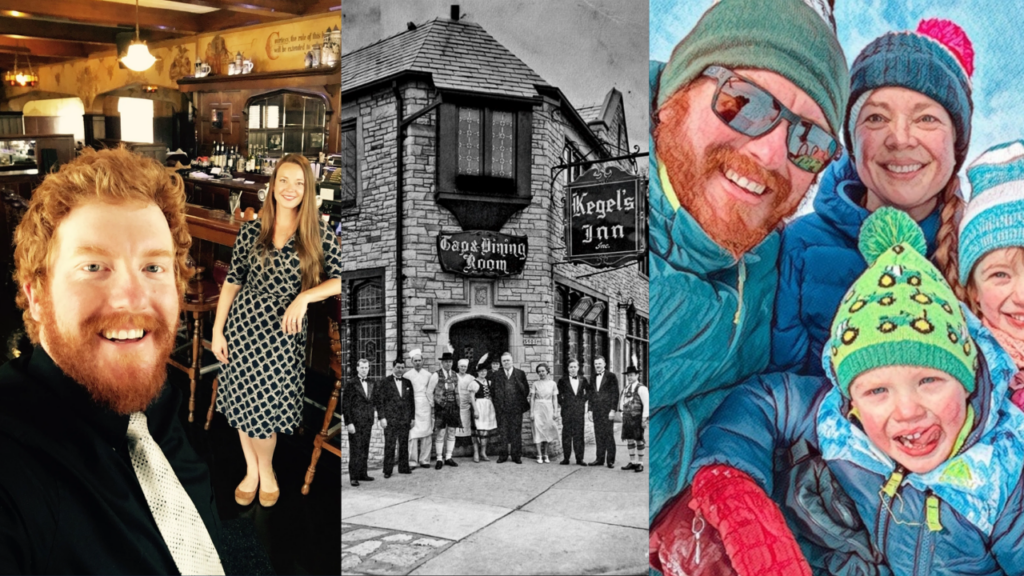
Julian Kegel’s path to becoming the fourth generation to operate Kegel’s Inn was anything but direct.
It was a winding journey – one whose experiences he wouldn’t trade for the world. From studying philosophy at UWM and an apprenticeship at an infamous bike shop in Dallas to completing a four-month bike trip down the West Coast and guiding in Alaska while living in his car, Julian’s seen and done a little bit of everything.
And now, for the last thirteen years, Julian’s adventure has been running the beloved German restaurant while figuring out how to do more for the community that’s supported it for more than 100 years.
We get into it all in this Q&A with Julian, so keep reading because his story is an adventure that you won’t want to miss.
What is your background (born here or a transplant – if so, from where)?
My name is Julian Kegel, and I always joke that I’m a bit of an outsider in my own story. Most people assume I grew up inside Kegel’s Inn, but I didn’t. I was a bike shop kid. My dad owned Wheel & Sprocket, so my childhood wasn’t built around kitchens or dining rooms, it was built around early mornings in parking lots, pumping tires, setting up for charity rides, and watching people come together around something they cared about. Looking back, that was my first real education in business. It wasn’t about transactions, it was about service. Show up early, help people, be useful. That foundation shaped everything I do now, even if it shows up today as slinging beers instead of fixing bikes.
Are there any stories from your youth that defined your path?
There’s one story that really stuck with me. I was on a week-long bike ride with my dad, and we had this traveling bike shop set up along the route. One of the riders came in with a flat tire, and my dad gave me the chance to fix it. I was probably nine years old. I had watched him do it a handful of times, so I figured, alright, this is my shot. Tire off, tube out, new tube in, pump it up. I remember thinking, this is it. Presta! six bucks, off you go. I felt pretty good about it. About an hour later, the same guy comes back. Flat again. At nine years old, I’m thinking, no problem, I’ve got this. So I do the whole thing again. Tire off, tube out, new one in, pump it up. “All set… six bucks please.” My dad overhears that and pulls me aside. He goes, “Julian, the customer didn’t pay you for the tube. He paid you to help him ride his bike again.” And that was it. I gave him his additional $6 back, and from that moment on, it clicked. It’s not about the transaction, it’s about the outcome. It’s about whether the person you’re helping actually gets what they came for. I think I’ve carried that with me ever since. Whether it’s fixing a bike or running a restaurant, the job isn’t just to complete the task, it’s to make sure people leave better than they came in.
Where did you study (if you did higher education)?
I went out to Portland, Oregon, and studied community development at Portland State University. It gave me a framework for thinking about how cities evolve, how people interact with spaces, and how community isn’t something you impose, it’s something you uncover and support. But I didn’t take a straight path to get there. I started at UWM studying philosophy and psychology, then spent a year in Dallas at Richardson Bike Mart, where Lance Armstrong got his start. The owner, Jim Hoyt, took me in almost like an apprenticeship, and that’s where I really started to understand business through service and relationships. After that, I took a four-month bike trip down the West Coast, from Jasper National Park all the way to San Diego. By the end of that ride, I found my way to Portland. After wrapping up the trip, I decided to transfer schools and move to Portland to fully immerse myself in its community and urban development. There’s a bit of a family tradition in there too. My brother went to McGill, so we rode our bikes out together, ten days, about a hundred miles a day, and dropped him off at school. Then it was my turn, and I joked I was heading to Milwaukee… nice easy thirteen-mile ride. But that stretch of time, the riding, the travel, and the people I met along the way probably shaped my understanding of community just as much as anything I learned in the classroom.
What do you do for work now?
Today, I’m the fourth-generation operator of Kegel’s Inn in West Allis, along with a few connected ventures with my wife and business partner, Stephanie. On paper, that sounds straightforward, but the reality shifts constantly. Some days are deeply operational, focused on staff, service, and making sure this hundred-year-old business stays open under my watch. Other days are more outward-facing, focusing on events, partnerships, or long-term ideas for the business’s future. We also operate the War Memorial Beer Garden, ALONG Milwaukee’s Lakefront, which directly supports veteran programming.
Additionally, we run Milwaukee Oktoberfest at the Henry Maier Festival Park with Swarmm Events, which has grown into something much larger than its humble beginnings in our parking lot on 59th Street. Over time, the role has evolved from simply running a restaurant to considering how that restaurant can serve a broader purpose in the community.
Can you talk a little bit about your career journey?
When I first started seriously considering taking over Kegel’s about thirteen years ago, I was coming at it from a pretty unconventional path. I had gone out to Portland for school to study community development, which gave me a framework for thinking about cities, people, and how spaces come to life. But after that, I didn’t go straight into anything structured. I went up to Alaska and worked as a guide, and for a stretch of that time, I was living out of my car. It wasn’t exactly a straight line career move, but it was one of the most formative periods of my life.
Guiding, especially in Alaska, teaches you something that’s hard to replicate anywhere else. Your job isn’t to carry people to the top, it’s to help them realize they can get there themselves. You lead from behind. You watch, you adjust, you encourage, and you teach people skills to keep moving forward even when they’re unsure. Around that same time, I met my wife, Stephanie, and we were figuring out a lot at once, seasonal lifestyles, a long-distance relationship, and what it meant to build something together.
There was a moment early on when Kegel’s felt like more than just a job. There was a glimmer to it, a little bit of magic. It wasn’t just a restaurant, it felt like a hidden gem. The kind of place I would’ve latched onto as a customer. A place with real weight. A hundred years of stories sitting quietly in the walls, an untapped well of history within Milwaukee’s restaurant scene that hadn’t fully been brought forward yet. There was a prestige to the role, not in an ego sense, but in the responsibility of it. It felt like stepping into something that mattered, even if I didn’t fully understand it yet. But once I stepped in, none of that felt philosophical. It was just work. I was completely immersed in the day-to-day. Every shift, every role, every hour. It was survival mode. There wasn’t time to think about vision or community impact because the focus was simply keeping the doors open and honoring something that had been around for nearly a century.
Over time, that began to change. We started to lift our heads up and realized that if we stayed buried in the mechanics forever, the business never becomes anything more than a job. It doesn’t evolve, it doesn’t contribute, it just exists. And that’s not why places like Kegel’s have lasted as long as they have. COVID was really the turning point. It forced us to move quickly, to experiment, and to let go of some of the traditions we thought were untouchable.
There was no playbook, so we had to rely on instinct and just try things. One of the clearest examples was when a musician asked if he could play his tuba in our parking lot. We said yes without really knowing what it would become. That single moment ended up bringing live music back into the restaurant after nearly a fifty-year hiatus, and now it’s a defining part of what we do. The journey hasn’t been linear. It’s been a series of small decisions, experiments, and moments of saying yes before fully understanding the outcome. And in a lot of ways, it still feels like guiding. You’re reading the terrain, adjusting to conditions, and helping people find their way forward, whether that’s your staff, your customers, or the community around you.
Can you talk a little bit about your community involvement?
A lot of my community involvement has grown naturally out of the business rather than existing separately from it. The War Memorial Beer Garden is a good example. It started as a simple idea to help an organization that was struggling to find sustainable funding, and over time it’s turned into a meaningful partnership that generates real financial support for veteran programming. I’m also involved with the West Allis–Tosa Chamber, where the focus is on helping businesses collaborate more effectively and build a stronger shared identity. But beyond formal roles, a lot of what I consider community involvement is just being open.
Saying yes to hosting events for local cultural groups, providing space for fundraisers, or supporting ideas that don’t fully have a structure yet. Our dining room, for example, sits empty most days now that we’re no longer open for lunch. Instead of letting it sit idle, we’ve turned it into a space where local organizers can gather, host events, and build something of their own. Sometimes the most impactful thing you can do isn’t leading something new, it’s creating the conditions for something to happen.
What are some ways you have impacted the community in your line of work?
I think the most meaningful impact has really come from something simple, the idea of the beer garden table. At its core, it’s about creating spaces where people actually interact with one another. Not just places where transactions happen, but places where community happens.
When you sit at a beer garden table, you can find yourself shoulder to shoulder with someone you didn’t come with. Conversations start. People share space. It lowers the barrier. That’s the essence of it. Closing a street to create a beer garden, programming live music, hosting community events, those are all just extensions of that same idea. They invite people out of their routines and into shared experiences.
There’s also a financial layer to it, especially with projects like the War Memorial, where business activity directly supports a broader mission. But at its core, the goal has always been to create environments that feel authentic and accessible, where people can show up as strangers and leave feeling like they’re part of something.
What do you like about living in Milwaukee?
Milwaukee still feels grounded. There’s an authenticity here that’s hard to replicate. People are willing to support what they believe in, and there’s a sense that things are still being built, not just maintained. It’s not overly polished, and I think that’s a strength. There’s room for ideas to take shape without being immediately priced out or over-optimized. It allows for a kind of honesty in both business and community that feels increasingly rare.
What do you want to see for Milwaukee’s future?
I’d like to see more alignment across the region. Less fragmentation between neighborhoods, cities, and suburbs, and more of a shared vision for what Milwaukee can be as a whole. There’s so much overlap in how people live, work, and move through this area, but we often operate as if those lines are more rigid than they really are. I also think there’s an opportunity to prioritize people over infrastructure. More walkable spaces, safer neighborhoods, and more places designed for gathering rather than just moving through. When people are visible and present in a city, it changes the energy entirely.
Anything else you’d like to add?
If there’s one thing I’ve learned, it’s that none of this works in isolation. There’s a tendency, especially in business, to try to control everything and carry it on your own. But that approach has limits. Kegel’s is still here because of the people around it, the staff, the customers, and the community that chose to support it when it mattered most. Learning to ask for help was one of the hardest but most important lessons. Now the focus is on returning that support and continuing to adapt. We found out a long time ago that our goal isn’t to preserve something exactly as it was, but to understand what it needs to become in order to last.