
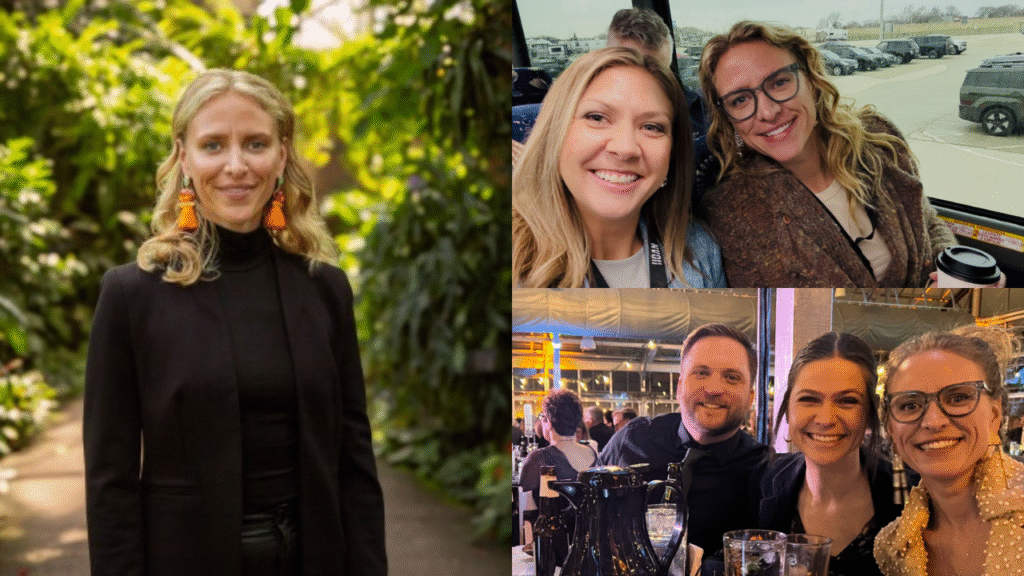
If Milwaukee runs on connection, Hanna Paul is one of the people helping wire the city together. The Appleton native came to Milwaukee to attend UWM in 2011, and despite a stint in San Francisco, she knew Wisconsin (and the 414 especially) was where she wanted to call home.
Since then, she’s built a career that spans healthcare, Silicon Valley startups, and now the local innovation scene, all while staying grounded in one core belief: relationships are what move ideas—and cities—forward.
Today, Hanna serves as Director of Customer Success at Milwaukee-based Ideawake, where she helps organizations turn good ideas into real innovation.
Outside of work, you’ll find her mentoring with Big Brothers Big Sisters, serving on the board of the Rotary Club of Milwaukee, hosting community dinners, or organizing spaces where new connections can happen, or walking Schlitz park with her partner Jackson and 3 year old Bernedoodle named Butter.
We caught up with Hanna to talk about her unconventional career path, building community in Milwaukee, and why small acts—like learning someone’s name—can make a city feel a whole lot stronger.
What is your background?
I came to Milwaukee to attend undergrad/graduate school at UWM in 2011 after graduating high school from Appleton, WI which is where I was born and raised.
Any stories from your youth that define your path?
Helping others has been a defining thread in my life for as long as I can remember. From an early age, I gravitated toward leadership roles in sports and my youth group. While school was often challenging for me. I’m naturally emotional, and that vulnerability sometimes made me an easy target. I learned resilience early. Each day felt like a battle, but I was fortunate to have an incredibly supportive family and a safe home environment that grounded me. That stability allowed me to channel my energy into youth leadership and deepen my commitment to serving others.
My care for people ultimately led me to pursue a career in healthcare as an occupational therapist. I worked primarily with mental health, veteran, and geriatric populations, experiences that profoundly shaped my understanding of how environment, trauma, and lived experience influence human behavior and perception. This work gave me both clinical expertise and a deep appreciation for the complexity of the human condition.
After earning my master’s degree and licensure, I moved to San Francisco, where I spent two years immersed in a fast-paced, innovation-driven environment. It was there that I caught the “tech bug. I became fascinated by the idea of reimagining healthcare delivery—finding the next transformative model that could do for healthcare what Lyft and Uber did for transportation. That curiosity led me into startup roles and, eventually, a full transition into the tech sector. I loved my patients; what I struggled with was the traditional healthcare model itself.
I later returned to Milwaukee to pursue a PhD, but after experiencing the velocity and agility of Silicon Valley, I found it difficult to readjust to the slower pace and bureaucracy of academia. I pivoted once again, stepping into a customer success role at a local telehealth startup for two years before being recruited into my current role at Ideawake.
If I trace the throughline of how I’ve arrived where I am today, it comes down to one thing: relationships. Every meaningful opportunity in my career has been rooted in trust, connection, and community. My earliest inspiration was my mother, who modeled both ambition and possibility. She taught me that there were no limits to what I could pursue and I’ve carried that belief with me every step of the way.
What do you do for work now?
I serve as Director of Customer Success at Ideawake, where I partner with organizations to design and operationalize meaningful innovation programs through our platform.
Most people have experienced the frustration of sharing a thoughtful idea—only to watch it quietly disappear into organizational inertia. Ideawake exists to prevent that. We create structured, visible pathways for ideas to be heard, evaluated, and built upon. Because when people feel that their thinking is acknowledged and expanded, not dismissed or ignored, it fundamentally changes how they engage at work.
Some of the most powerful innovation happens in the space between people. You share an idea. Someone else builds on it. A third person refines it. That collaborative amplification is what we enable. Across industries and roles, I’ve found that creativity is rarely the limiting factor, psychological safety, clarity, and process are.
My background as an occupational therapist deeply informs how I approach this work. OT trained me to assess systems holistically: people, environment, constraints, culture, and behavior patterns. I now apply that same lens to organizations. I design tailored idea management ecosystems based on a company’s resources, readiness, and internal dynamics, including the inevitable “red tape.”
Innovation is not one-size-fits-all; it’s contextual and human.
I also challenge leaders to think relationally. If you want meaningful ideas from your employees or customers, there must be reciprocity. Innovation thrives in environments where people feel valued, not extracted from. At the core, we all want to know that we matter and that our perspective contributes to something larger than ourselves.
Perhaps my favorite part of the role is working with highly analytical, linear thinkers and helping infuse a layer of humanity into structured systems. Often, transformation doesn’t require sweeping change, just thoughtful micro-adjustments in how we listen, respond, and design experiences. That’s where sustainable innovation lives.
Can you talk a little bit about your career journey?
Overall, I went to UWM for my undergrad and masters in OT. I graduated and jumped right into travel therapy and landed my first job in SF. I knew no one but was in need of change.
I quickly could see the burnout the healthcare model would lead to. So I started looking around at start-ups.
I landed my first start-up job at a company called Karuna VR running their clinical research trials to assesss the use of virtual reality to treat chronic pain. The goal was to improve people’s relationship with pain and decrease reliance on opiates.
Start-ups are fun but they do not provide a steady foundation. After 2 years of this work, I knew it was time for a change. I was offered a full-ride for a PhD to return back to MKE.
I worked on a national grant for a project creating the yelp for people with disabilities so they could be active community members having access to a data set that informed them what spaces and places were designed for them. My advisor was not open to my ideas on needing to use advanced technology like google maps does in order to collect this database so I decided to discontinue the PhD program 6 months in. That and being told I had to take the GRE after moving across the country and already being accepted into the program and enrolled in coursework… I don’t believe in red tape like that.
So I became employed, nannied in my spare time and landed a job at Vytal Health. There I tried on many hats, social media, marketing, customer success, sales, business development and found I thrived in the relationship side of business. This was a unique time in where I felt very lost and not sure what to do. Go back to school? Go into coding?
I remember going to an event for Rev Collective (no longer exists) and a speaker asked the room ‘who here is doing anything with their degree in their job?’, less than 40% of people raised their hands. This is when I started to learn to market myself as someone who would be an asset to any company and not as an OT looking to find a new career.
I was then recruited by my current boss 4 years ago and did a complete change from health care into the world of innovation. He heard about me from a current employee and from the employee who was leaving the role he was recruiting for.
Can you talk more about your community involvement or volunteer experience?
Community involvement is a meaningful part of my life, and I’m incredibly grateful to work for a leader who champions that. My boss, Coby Skonord, understands that a sense of purpose fuels how I show up professionally. He sponsored my participation in the Forward48 program, which ultimately led to a six-month trial and now official membership with the Rotary Club of Milwaukee.
At Rotary, I currently serve on the board and contribute to committees focused on membership engagement and social programming. One initiative I’m particularly passionate about is our Art Connector series, curated experiences that bring Rotarians together outside of our Tuesday meetings to explore Milwaukee’s arts community. Creating spaces for connection beyond formal agendas has been both energizing and impactful.
In 2024, I co-chaired the first gala for the Mitchell Park Domes, where we exceeded our fundraising goal by more than double. My connection to that work stemmed from volunteering in the Children’s Center at the domes, where I met the Milwaukee Domes Alliance CEO, Christa Beall Diefefnbach and briefly served on the board.
While the organization had strong leadership and momentum, I recognized that my strengths could be better deployed in spaces that needed activation and growth, and I’ve tried to be intentional about aligning my energy accordingly.
Most recently, I became a mentor with Big Brothers Big Sisters of Metro Milwaukee. I met my Little two weeks ago, she’s eight years old, creative, curious, and eager for new experiences. I’m excited to grow alongside her. I was inspired to get involved after hearing Richie speak about BBBS on his podcast; it was a powerful reminder that consistent presence can change a child’s trajectory.
I genuinely love Milwaukee. I try to impact what’s directly in front of me each day — whether that’s holding a door, picking up trash in my neighborhood, or asking my server their name so I can thank them personally. There’s something powerful about acknowledging someone by name. It’s a small act, but it affirms dignity. And to me, community is built in those micro-moments just as much as in boardrooms and galas.
What are some ways you have impacted the community in your line of work?
Serving on the board of the Rotary Club of Milwaukee has been incredibly meaningful. It’s one thing to believe in service… it’s another to help steward resources that tangibly impact your city. I’ve had the privilege of contributing to funding decisions that have supported initiatives like Stella’s Playground, Feeding America Eastern Wisconsin, and other local nonprofits responding directly to community needs. Being part of those conversations has deepened my understanding of thoughtful, needs-based philanthropy.
I live in Brewers Hill, and I try to practice service on a micro level too. Just this past weekend, I picked up 30 bags of dog waste that had surfaced from beneath the snow. I could have complained but instead, I reframed it. It got me off my phone, gave me movement and fresh air, and signaled care for my neighborhood. Community isn’t only built in boardrooms; it’s built in small, visible acts of responsibility.
I hope my efforts inspire others to contribute in ways that align with the season they’re in. Not everyone can give time, money, or leadership in the same way, but everyone can participate in strengthening what’s around them.
I’m also deeply energized by creating intentional spaces for connection, particularly for women. I host curated dinner parties, design community-centered gatherings, and recently launched a free Coffee Connector, a low-barrier way for women to meet, share ideas, and expand their networks. There’s something powerful about bringing thoughtful people into a room and watching relationships unfold. That, to me, is community-building at its best.
I also love to hand out small items. I used to be a big festival girlie and there is so much love and creativity in those spaces. I always have buttons, little trinkets like hearts, flowers, buttons with positive affirmations or stickers that say ‘the world needs your magic’ on them. We all need reminders of that and it’s an easy thing to do without having to spend a lot of time doing so.
What do you like about living in Milwaukee?
The accessibility. The lake. The summers. The food. The river. The parks. Being close to my family.
What do you want to see for Milwaukee’s future?
Northside development. Larger numbers of community members taking ownership of their communities and being of service.
Whether volunteering or picking up trash on their walk instead of saying, “Someone else will get it.” More people who know what it means to listen to the phrase: ‘If not me, who?’
A better airport. More art everywhere. On the riverwalk bridges, murals on the walls, improved traffic lines, more pedestrian friendly/people forward designs.
People inviting new people to their tables. MKE is clicky! When’s the last time someone new was added to the table? I have had to call myself out on that.
Neighbors who know their mailman/womans name, people who see someone is lost and offers directions… we have become so disconnected… I want to see more park hangs with large groups… there’s so much!