
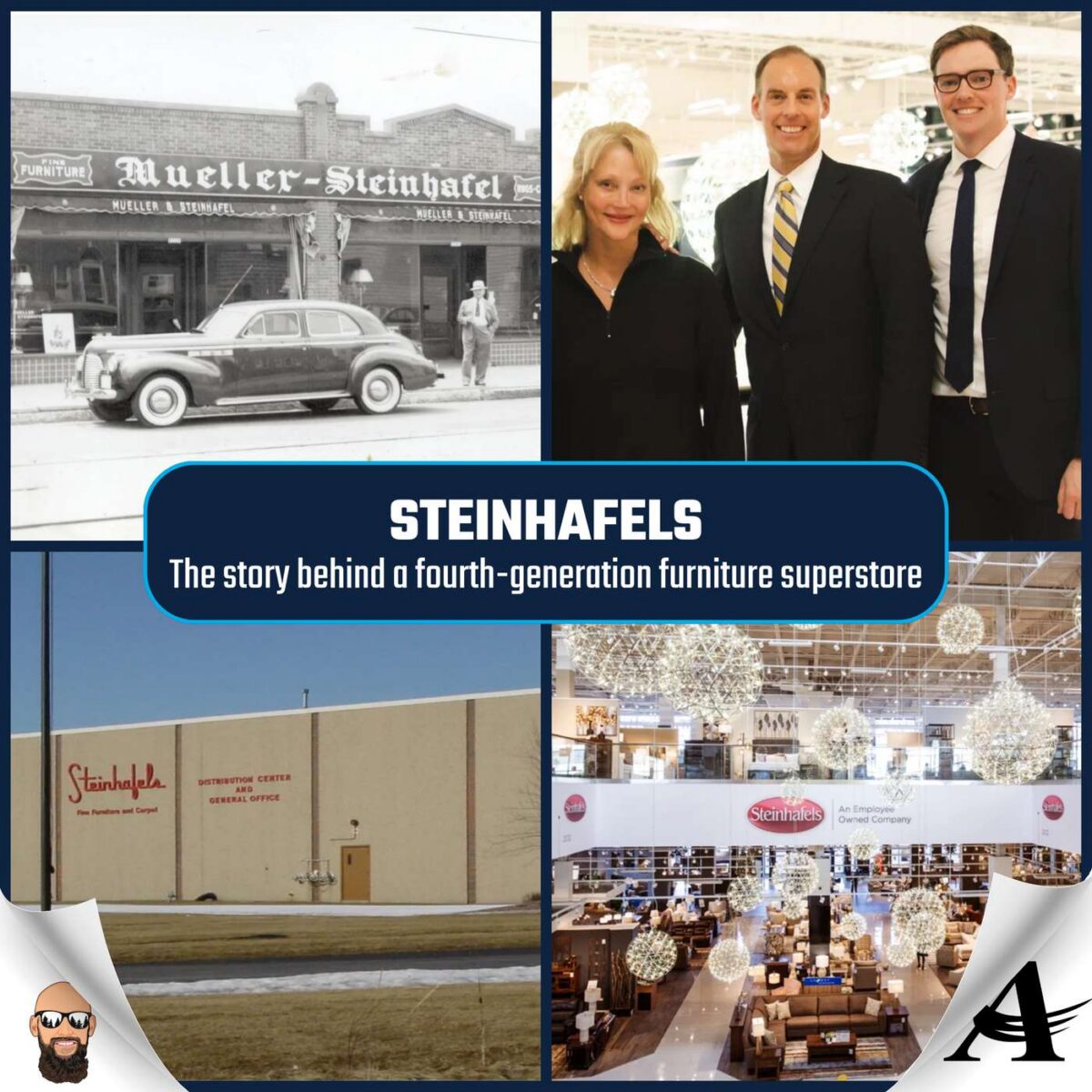
How did Steinhafel’s transform from a single furniture store in Milwaukee to having 16 locations across Wisconsin, Illinois and one in Indiana as well as their 420k square foot warehouse in Waukesha?
It’s an amazing Wisconsin business story where we are joined by 4th generation President of the Company Andrew Steinhafel. We cover:
- Steinhafels origin story
- Earliest memories in the business
- Why Steinhafels is successful while most family businesses fail by the 3rd generation
- Why Steinhafels created an ESOP
- Competing with Amazon and big box retailers
- Expansion & determining new lines of business
- Most underrated piece of furniture
SPEAKER_00
0:00
Biggest hurdles that the business had to overcome. Big economic shocks that have happened, the great financial crisis. And they had just opened a store in Menominee Falls in 2006. And then two years later, real estate market collapsed and we're we're tied to the housing market. Amazon and the big boxes certainly have been relatively disruptive. I think they've changed consumer expectations. So it certainly challenged us to up our game and improve our business. A lot of our success has come from the very direct conversations you have to have when it's a family business and trying to separate the family portion from the business in some of those conversations. The first generation from the second generation, all five siblings were in the business. The three brothers went off and fought in Korea and all came back to join the business with the two sisters, and they worked together for, you know, close to 40 years.
SPEAKER_01
1:05
You're going to learn how Steinhoffels transformed from a single furniture store in Milwaukee to having locations across Wisconsin and Illinois and one in Indiana, as well as their 420,000 square foot warehouse in Waukeshaw. It's an amazing story. And joining me today, we've got fourth generation president of the company, Andrew Steinhoffel, who tells the story, also gives some great insights on what makes Steinhoffel successful, especially in this day and age of Amazon and big box retailers. It's a good one. Before diving in, I just want to thank our partners who make Milwaukee Uncut possible. If you're looking to get your finances together before the new year, which is a great time to do so, reach out to the experts, our good friends over at Annex Wealth Management. Annex is a holistic wealth management firm with offices in and all around Milwaukee that helps you with everything: retirement planning, smart investing, estate planning, legacy planning, and tax strategies all under one roof. Annex know the difference. Nicola, the Midwest law firm, injured. Get Nikolain Russell, and the team will take great care of you. Great people over there at Nikola. They've got an office right here in the third ward and all across the Midwest. And last but not least, Drink Wisconsinably Beverage Company, best vodka brandy and canned cocktails in the game, available at bars and liquor stores across the state and at the DW pub, the Drink Wisconsinably Pub right across from the Pfizer. All right, let's dive in with Andrew Steinhoffel.
SPEAKER_00
2:41
In 1934, it started with my great-grandfather, who was actually uh grew up working in some furniture stores. As in the story goes that he was an elevator boy in a furniture store, talked his way onto the sales floor, became a furniture salesperson. And then he and an older gentleman by the name of Arthur Miller, both salespeople, went out to start their own uh furniture store, originally called Miller Steinofel Furniture.
SPEAKER_01
3:08
And you you grew up around the business quite a bit. What what were some of your earliest memories?
SPEAKER_00
3:13
Yeah, I remember our old uh warehouse in New Berlin where we used to hold these massive warehouse sales and we'd invite the public into the warehouse and they could uh purchase odds and ends, you know, in stock sofas, everything, everything had a go type mentality, and worked a couple of those big warehouse sales as a small kid. Uh I was uh a little bit more uh technologically inclined, so I was often the one hooking up printers, you know, under the desk, putting the computers together, things like that. Do you have any fond memories of those or what were your favorite things about doing that? I'd say the fondest memories honestly were the the people. Obviously, it's a family business. And so I remember my grandparents being active in the business, which was really fun. Um, I also remember uh one of our one of my favorite people and my brother's favorite people was Gretchen, who was the receptionist there and would always have to buzz us into the door. Uh, and she'd always have some candy for us as we walked in, and she was so kind to us as you know, little kids in the business. How many siblings do you have? I I have four brothers, but I'm the only one still in Wisconsin and working for the business.
SPEAKER_01
4:18
Are you the middle? Are you the oldest? Are you I'm second? I'm second in the line of five. Okay. What was it like? Were those guys working those sales too? Did you get did you guys fight it all over there? Were you jumping around on the furniture?
SPEAKER_00
4:29
Was it we've run around a furniture store or two, and especially uh when it was our Madison store in 94, 95 was being built. Uh, have a memory of just a giant concrete building. It was empty at the time, but they had put in the warehouse racking in the back. And so my older brother and I had the great idea of let's climb up the warehouse racking and run through the pellets uh down the down the stairwell. And we got yelled at pretty good for that.
SPEAKER_01
4:58
Started as a small store in the 30s. What was the growth trajectory like? Were there any any big moments of expansion, any failures that the company really had to make it through?
SPEAKER_00
5:09
Yeah, I I think it's a kind of a true American dream story where my great-grandfather started the business with his partner, Arthur Miller. They had one store. Uh Arthur Miller unfortunately passed away a few years after they had started the company, so he bought out his widow. Uh, and then the it was a single store operation for quite a while and it bounced around from different locations across Milwaukee. Eventually, the the second generation got involved in the business and they moved the one-store operation out to what was at the time an up-and-coming area at uh Capitol Court on 84th and Capital. And that was a big gamble at the time, I think, based on the the bank loan they had taken. They projected they had to do about a million dollars in sales just to be able to break even that first year. And it was a big move. And that was back in what year? 1959. So that's a that's a high volume of sales for a single store in the 50s. Right. Right. But they did it, and uh that store really did well for us for a long period of time. And then they they opened their first second store about 10 years after that, uh, in uh the south side of Milwaukee in Greenfield on 84th and Leighton. So that store was in that community for a long time, and we actually just uh moved that store into the 84 South uh development there with a brand new build ground up, which is just spectacular.
SPEAKER_01
6:35
And then what was the highest period of growth? Obviously, a single store was one for a while, and now there's 18.
SPEAKER_00
6:43
Yeah, the the second generation grew it to three stores, and then in the 80s, uh the 1980s, they started slowly transitioning out. There were some retirements in the family. Uh, they started bringing in the third generation. Uh my dad joined the business, and two of his cousins joined the business, Mark, Gary, and Ellen. And they were still a three-store operation with a distribution center in New Berlin. And the third generation really took it to kind of a next level over the next 20, 30 years. Uh, they had their first Madison store in in 95, uh, the Kenosha store opened in 98. And then I'd say the the next kind of really big leap happened when we opened up the Waukeshaw facility out on uh 94 and Highway F. With that was a a huge uh investment at the time to build out that facility, the distribution center, the store, uh, and that really set us up for growth into the future. What year was that? That opened in 2004, but it was it was being worked on starting in 2002. It was a 60-acre farm bought from the Graf family out there, and yeah, it it's uh a beautiful store. It's 160,000 square feet, but it's incredible to think that it's about 20 years old now, and we're talking about some updates to the store and some remodels that might need to happen. When did the first out-of-state store happen? The the first Illinois store opened in Vernon Hills, uh just north of Chicago, a northern suburb of Chicago in 2011.
SPEAKER_01
8:11
Any any biggest hurdles that the business had to overcome to get to where it's been today?
SPEAKER_00
8:17
I'd say in in recent history, it's been the big economic shocks that have happened. I remember I wasn't in the business, but I remember my dad and uh his partners and the family dealing with a great financial crisis. And they had just opened a store in Menominee Falls in 2006, and then two years later, um, you know, the real estate market collapsed and we're we're tied to the housing market. People often buy furniture when they they move or buy a new home. And business dropped all of a sudden 25 to 30 percent in one year. And so, you know, that that was a huge shock uh to the business, but they were able to survive it and grow actually, you know, eventually they were able to grow through that time period in 2009 and open up some mattress stores, and then in 2011 went into Illinois. Can you speak much on that?
SPEAKER_01
9:07
It's pretty rare that a company would a furniture company would grow during that period when the housing market has collapsed.
SPEAKER_00
9:13
Yeah, one of our core values or core principles as a company has been financial prudence. And we've always, as a small family-owned or privately held business, we've always thought that um, you know, it's it's best if we can control our own destiny and if we're not uh beholden to others, especially with a lot of debt. So during that time we had very little debt, and that's really what allowed us to um, you know, during that time that the family really streamlined the business and reduced expenses and was able to survive that period in a financially stable way and even remain somewhat profitable during those years. And then coming out of it, as we saw uh the housing market start to rebound slowly, they were able to reinvest back into the business, um, expand and expand with some stores.
SPEAKER_01
10:00
Um when you when you speak to that, have there been I'm sure there's a lot of opportunities on the table, a lot of areas that, hey, we could get into this, we could get into this, we could get into this. Are there any decisions that maybe maybe you've made or you've seen your family made that you're like, wow, I'm glad we've avoided that, or hey, maybe we should have been more aggressive here?
SPEAKER_00
10:23
That's a good question. I I think the one thing we've we've looked at a couple times in the company's history is expanding our product line. We're we're in furniture and mattresses, and that's kind of always stayed our core competency. We we feel it's pretty important to stay relatively focused. Uh, we've looked at appliances several times. Earlier, you mentioned the American TV uh going out of business, and we acquired a couple of their stores. At that time, we looked at the appliance business, and what we really walked away with was it's a very different business. And we we were not prepared to take that on. And I kind of think the families did an amazing job over the years, and that's why we've survived 92 years uh to really try to understand the business behind it, how um who the players are, how you would make money, things like that, where and we've stayed away from that specifically.
SPEAKER_01
11:21
And obviously you you have a a large variety of of products under the under furniture, but has it always been that way since the start and you've just stayed on that kind of furniture and mattresses line?
SPEAKER_00
11:33
For the most part, I you know, the family has gotten into things like uh carpeting and rugs. Uh they've been we've been in and out of different sectors, but we've always tried to, you know, we have a I think we have a culture of experimenting and testing, but keeping it a well-defined test. And and if it works, we can always do more, um, but not kind of overinvesting or getting over our skis on something. So, you know, carpeting we were in in the 80s and 90s and then got out of that business. Uh, and recently we've actually gotten back into the flooring business with a small test uh down in the Illinois market with a partner that's that's going pretty well.
SPEAKER_01
12:11
Um most family businesses collapse on the third generation, it is said. You're you're the fourth business seems to be doing well. What do you feel makes a makes a family business work over four generations? And where do you think a lot of them fall?
SPEAKER_00
12:30
I think our a lot of our success has come from the kind of very direct conversations you have to have when it's a family business and trying to separate the family portion from the business in some of those conversations. Um I I think where we've done well, it's it was not a given that people would come into the business. It was not an expectation. The expectation was actually the opposite uh for my brothers and I of you need to go get experience elsewhere, and then you need to be able to bring that experience back to the company to the benefit of the company. Uh and there is no expectation that you rejoin the company, and if it if you do, it's wonderful, and if you don't, that's great too. So you were allowed to work in the business growing up, but not right out of school. The expectation was uh after college, we would go get our own experience, our own job elsewhere in a field we were passionate in. And then if there was a uh a good time or or some sort of um again uh beneficial relationship that could happen, we could figure that out.
SPEAKER_01
13:37
Is that always been the case or was that new with your generation? And and what do you think the benefits of that were?
SPEAKER_00
13:42
I I know the second generation had that rule for the third generation of hey, go do go do your own thing. And if there's uh again, if it works out for the business and for the individual, that's that's wonderful. Um, the first generation from the second generation, all five siblings were in the business. There were three brothers and two sisters, all equal owners in the business. Um, the the three brothers went off and and fought in Korea and all came back to to join the business with the two sisters, and they worked together for you know all close to 40 years.
SPEAKER_01
14:13
So you had to, you couldn't work in the family business right out of college. What did you end up doing?
SPEAKER_00
14:18
Yeah, I actually went to school for business and computer science out in Boston, ended up working for some software companies out there for five or six years, had that IT and technology background, and um actually was getting married to my wife, uh, who's also from Wisconsin. And we had a party the night before our wedding. And my uncle Gary, uh, who was our former president, was there and gave us the hard pitch on coming back to Wisconsin, joining the family business. And wouldn't that be great? And I had to stop him and say, you know, Gary, it's we're I'm getting married tomorrow. Like one big life decision at a time. Um, you know, we'll we'll figure this out. But but it was about a year later we ended up moving back and joining the family business, and it was one of the best decisions.
SPEAKER_01
15:05
So uh Gary, your dad's brother comes cousin. Okay, your dad's cousin is at is this at the rehearsal dinner? Yes, basically. And instead of congratulating you on your wedding, he's just putting the hard hard sell on you. Hard sell.
SPEAKER_00
15:17
Move back to Wisconsin, join the family business, it'll be great. And it and it has been. That's right.
SPEAKER_01
15:27
It made moving back to Wisconsin a little easier that she was also we have you both have family here. Double sell her on that, and the pitch worked out. Um, with your IT background, did you did you see things Steinhoffels could be doing differently? And you were like, hey, I won't I want to come back. I they could use my help doing this and really think that you could add value to the business.
SPEAKER_00
15:49
Yeah, I I think uh a couple of things. One was e-commerce. We had a website, but it wasn't a real transactional e-commerce website, and thought that was an opportunity. Um then, you know, over time we've slowly upgraded our internal systems, our point of sale system to make it easier for our sales associates and stores to transact. Um, but you know, we were we were in a good spot before just kind of again helping us continue to push into the future.
SPEAKER_01
16:14
Um you mentioned having direct, candid conversations is very critical. Are are you good at that or is that difficult to do?
SPEAKER_00
16:22
You can always be better at it. Uh, but I I do think, especially when it comes to family, it's it's always um, you know, you always lead with kind of good intentions, and I I think that helps. And so uh yeah, we you know, we've had to have some very candid conversations. We've had those difficult time periods in our company's history, the the great financial crisis, COVID when we were shut down for three months. Um so yeah, we've we've had to go through some of those.
SPEAKER_01
16:48
What was what was COVID like?
SPEAKER_00
16:52
COVID was interesting. It was were you president at that point in time yet? Or were you I was vice president and took over as president shortly after about a year after that. Which COVID was still kind of going on at that point. Yeah, and it was really interesting during that time, you know, when we were closed, it was gonna be this, you know, not to rehash COVID, but it was gonna be this two-week period. Uh, and then it that turned into four weeks, and then each municipality and county and state had their own rules and regulations of you could open up, you you couldn't. And so it was just a really challenging time. We were trying to figure out how best to navigate that with our employees, how to continue to offer them health insurance during that time uh to give them some sort of stability, and then also how to make sure that we had a a functional business coming out of COVID, if and when we were allowed to reopen. Has that been the toughest stretch while you've you've been there? That was definitely the biggest challenge I've had to face, yes.
SPEAKER_01
17:55
Um I want you to speak to the culture. You got you guys are an eSOP as of somewhat recently, right? Can you touch on the decision to move to to an eSOP and how you maintain a strong culture at Steinhoffels?
SPEAKER_00
18:10
Yeah, we became an eSOP just over five years ago, uh in 20 early 2021. And you know, with the family, we were doing some succession planning, uh, had some challenges with the next generation not showing the same level of interest as the previous generations. We were also a much larger business. And one of the options we looked at was an eSop. And and as we learn more about what an ESOP is and how we think it can help uh protect and continue the family legacy, we became more interested in it. And then there's also this wonderful benefit for the employees that really you know can reward the employees in a substantial way for the value they bring to the business as well.
SPEAKER_01
18:54
Do you do you want to explain to people listening who don't know what an eSOP is and how how it works?
SPEAKER_00
19:00
Yeah, it's it's an employee stock ownership plan. And essentially the family sold the business into an employee stock ownership trust. There's a trustee that's responsible for um overseeing and providing governance for us. But we sold 100% of the company, and uh it is now 100% owned by our employees, and so it's a it's a retire of retirement plan. There's some nuance to it. Um, but the the big benefit for the employees is that as you stay, you accumulate shares, and then those vest over time, and that's uh tied to a share price and the value of the company. So as the value of the company continues to go up and you start to accumulate shares, you can have a really nice uh dollar figure in your retirement account. So it's a really great benefit for the employees.
SPEAKER_01
19:50
And then competing today, you've got, you know, obviously the rise of Amazon, people buying off there all the time, other big box retailers. How have you managed to grow and be successful in in this period? And how disruptive has Amazon been to the furniture business?
SPEAKER_00
20:06
Amazon and the big boxes certainly have been relatively disruptive. I think they've changed consumer expectations. I think consumers are expecting a you know more modern digital experience for sure. Also, they're expecting to be able to get things quicker and have more choices. Uh so it certainly challenged us to up our game and improve our business to at least match those consumer expectations, um, you know, with things like speed to market, um, delivery windows near term. So they while we might not be Amazon Prime and be at your house this afternoon, within a few days we can have uh the furniture in the home. And with, you know, I think we also continue to have a competitive advantage advantage over the online only guys when you look at the fact that our delivery teams are all employees. We own all the trucks. There are employees, there are people coming into your home to set up the furniture. Um, our our job is basically to curate the assortment to make sure that it matches the consumer preference and and then be able to deliver on some of those promises. So while it's certainly been disruptive, I think we we have enough of a differentiation that it's we've been somewhat uh protected from some of those.
SPEAKER_01
21:21
So when people make buying a new mattress, buying a table, buying a nice chair, couch, um those are higher dollar purchases for people. Are you more immune to Amazon because people want to actually physically go in the store and sit down on something before they're gonna sit down on it that thousands of times, probably?
SPEAKER_00
21:42
That's that's absolutely a factor, yes. Where if you're spending a few thousand dollars, you want to make sure you're getting the right mattress or you're getting the right sofa, to your point. Um, where we've seen maybe a little bit more uh competition from Amazon and others is at some of the lower price points where if you're buying a mattress. For uh your guest room. You you may not care or want to come in and test it out as much as you would uh for your your primary, you know, primary suite.
SPEAKER_01
22:10
Um can you speak to Stan Hoffel's charitable impact and why that's important?
SPEAKER_00
22:16
Yeah, we partner with uh uh several organizations within the community. Our big philanthropic partner is special spaces. They they do uh bedroom makeovers for children with cancer and other ailments. And uh we we've started that uh in Wisconsin and expanded it into Illinois now. And we we do things like the every time the Packers uh hit a field goal, we we donate a thousand dollars. Um so they're our large philanthropic partner, but we we certainly support a lot of our uh associate causes as well.
SPEAKER_01
22:48
Hopefully you guys will have to donate more money this year. The kicker's looking better than last year so far. Much better. Smack. Yes. Um and what uh what comes next for Steinhoffels and what are some of your future focuses?
SPEAKER_00
23:02
We've expanded pretty aggressively over the last few years into the Chicago market. There were some uh competitors that were going out of business, which opened up some opportunities for us. And so for this year, uh we spent the last two years opening three new stores down there. So this year we're we're taking a breather and taking a little pause. Um but yeah, Chicago continues to be an opportunity for us. And I also think to your earlier point, we've got to continue to improve our business to make sure we're matching consumer expectations and reinvesting, especially in our digital experience.
SPEAKER_01
23:35
How do you evaluate whether or not you should buy a store that's not doing well? That's a good question.
SPEAKER_00
23:43
Uh usually we look at everything from the actual physical building, its its shape. We put together a budget around what we think it would take in terms of dollars and timeline to make it a Steinhoffels. We we have a pretty high bar when it comes to uh our visual representation in a store. And and then we also look at the demographics and the kind of surrounding areas, and does that match our current customer?
SPEAKER_01
24:09
So it's it's obviously the location needs to be good, but you can go visit a store, see if it's underperforming, visualizing. Hey, if this is a Steinhoffels and we do everything right, the volume would be much higher there, essentially. Exactly right. What would be the biggest misconception about running a furniture business?
SPEAKER_00
24:28
I think it's that people just expect that we uh lay on mattresses and sit on sofas all day. And you know, there's actually a lot of hard work that goes on in the background. While I my wife was making fun of me because I was actually laying on some new mattresses last week that were Yeah, I I'd do that whenever we're in the store.
SPEAKER_01
24:46
Those things are comfy. Yeah.
SPEAKER_00
24:47
But we were looking at a new new mattress line we might want to bring in. And um, yeah, but there's there's a lot going on. And I I think number two is that uh the size and scale of our operation, a lot of people don't know that we're outside of Milwaukee, that we're in Appleton, Green Bay, the Madison, uh, and Illinois. So it's it's a little bit bigger of an operation than people expect.
SPEAKER_01
25:08
What do you what do you think the most underrated piece of furniture is or something that should be in every house?
SPEAKER_00
25:15
I I think it's your pillow and your mattress. You you spend a third of your life on your mattress. People offer often um, like you were saying, come in and test out a mattress. Well, you really need to lay on that mattress for a period of time to make sure that your body can adjust to it. You lay on it for three minutes, it's not gonna be how it feels, you know, three hours into you sleeping. Uh and the other one is is pillows. Um, I joke that we have a a significant investment in pillows in our house right now. Um and that, you know, often people just use their old pillow when really you should be considering, and not to be a salesperson, but you should really be considering a the sleep system as a whole, your your pillow, your mattress, uh, because they all impact your sleep.
SPEAKER_01
25:59
That was good advice. Has anyone ever just fallen asleep in the store on some of those mattresses? The massage chair you have in there is very nice as well.
SPEAKER_00
26:08
Many times. Yeah, many times. And and we actually welcome that. We want people to be able to try out their mattress and make sure they feel comfortable.
SPEAKER_01
26:14
Has anyone had to wake someone up like it's what time do you guys close? Nine, nine ish? Eight o'clock. Eight o'clock. Have you had to wake people up at 7.59 before? That has happened before, yes.
SPEAKER_00
26:26
Did that happen to you?
SPEAKER_01
26:27
No, not no, not me. I mean, I've had other people or around me that very well could have at one point in time. But uh no, I've I've avoided that. Um, do you have any advice for couples who are going furniture shopping? Uh that's interesting. Um, my advice would be to have you seen have you seen any you know our arguments in the in the store? Do those happen?
SPEAKER_00
26:51
It's not uncommon, but but my advice would be to work with a professional, either one of our designers or one of our great salespeople, and they should be they're used to being able to help people navigate that uh with especially with the but they they are very knowledgeable and good at what they do and can also serve as a third-party mediator.
SPEAKER_01
27:11
Absolutely. Yeah, I'm sure you have a pretty good training program for for those people. For marital counseling. Yeah. That might that might help. Um, what are what are you most proud of when it comes to Steinhoffels?
SPEAKER_00
27:26
I I'm proud of our ESOP and the the growth we've been able to sustain over the last few years. I think it was um, you know, three stores and a distribution center in about an 18-month timeline really uh stressed our company a little bit and our our team was able to execute and we've you know we're a better company for it. So the last two to three years have been uh challenging and and we're now that we're taking a breather, it it feels a little bit easier. So um yeah, that that's what I'm most proud of. That's really good.
SPEAKER_01
27:57
Uh one more thing I I wanted to ask you. How do you uh how do you figure out when you're bringing in a new line? What is that process like? Because you have a lot of different ones.
SPEAKER_00
28:07
Um yeah, the the furniture industry as a whole, we joke that it it's kind of stuck in time. Uh four times a year our our merchandising teams still go to the furniture markets. Two times a year it's in North Carolina, and two times a year it's in Vegas. And and what they're there to do is to see our current vendors, see any new product introductions, and also see potential new lines or new vendors that we want to work with. Uh and so yeah, four times a year they're traveling to go find new product and see what the latest trends, colors, etc. are in the marketplace and make sure we stay up to date. Are there any local interesting vendors in in Wisconsin that you all work with or uh a big one that's a a great solid wood dining line is is Whitmer, um, Bedroom and Dining. And they do a great job, and they're a Wisconsin company, um, and and they make beautiful furniture.
SPEAKER_01
29:04
Hey everyone, thanks for tuning in to this episode with Andrew Steinhoffel and just want to thank our partners quick before signing off who make Milwaukee on Cup possible. Drink Wisconsin Bleed Beverage Company, Nikola, and Annex Wealth Management.