
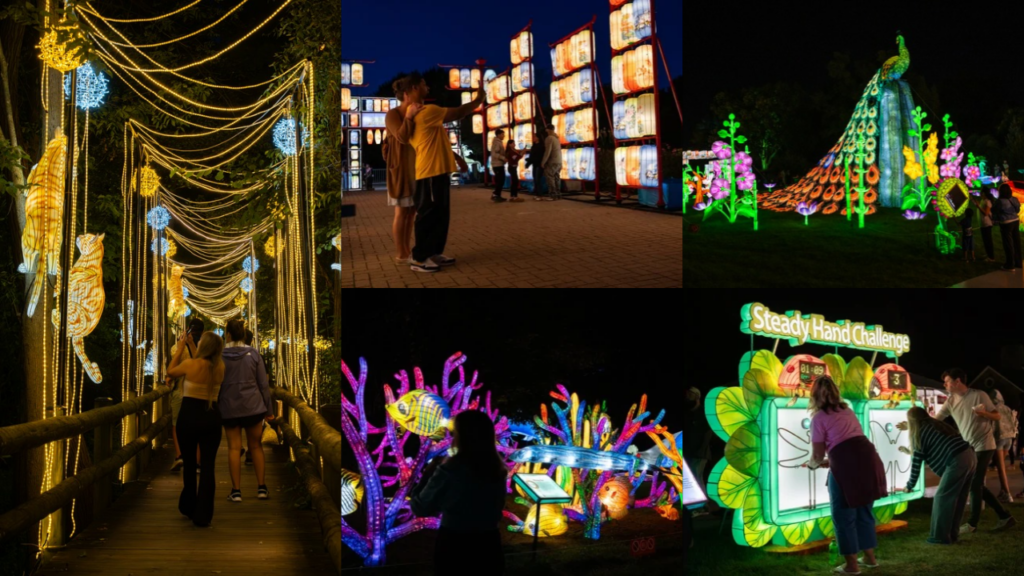
For a couple of months each year, the Boerner Botanical Garden in Hales Corners transforms into a dazzling display of lights, lanterns, and color thanks to the team at Tianyu Arts and Culture. Based in Zigong, China, a city revered for its traditions of lantern-making, Tianyu partners with botanical gardens and other venues across the United States to bring ‘China Lights’ – a Chinese lantern festival – to American audiences.
Thousands of lights and lanterns, along with 40 large lantern sculptures, illuminate the dark skies, filling visitors with a sense of awe and wonder as they make their way through the display. This year’s theme, “Legends Come Alive,” has exhibits featuring a unicorn, bear forest and coral reef corridor. There’s also interactive experiences, live Asian folk art and acrobatics, and food and drink to round out the experience.
So, what does it take to bring this lantern experience to life every year? We talked with Tianyu Arts & Culture’s business development manager, Jessie Li, to get an inside look at how this Chinese Lantern Festival came to Milwaukee County, the logistics and timeline behind a project of this scale, and what visitors can look forward to as they journey through the botanical gardens.
What is your role at Tianyu Arts & Culture? How long have you been with the organization? What do you do in your position?
I’m Jessie Li, Business Development Manager at Tianyu Arts & Culture, and I’ve been with the company since 2021. I work with venues to bring Chinese lantern festivals to their communities, from identifying potential partners to developing agreements to host an event.
A big part of that work is understanding what makes each venue special and how a lantern festival can fit its setting and audience. We want to build partnerships that give people a reason to return, with a new experience each season.
What exactly is Tianyu Arts & Culture? What’s the mission behind the organization?
Tianyu Arts & Culture produces Chinese lantern festivals in partnership with botanical gardens, zoos and other venues across the United States. We’re the U.S. subsidiary of a company founded in 1997 in Zigong, China, a city celebrated for its lantern-making tradition. Our team handles the process from original design and handcrafted lantern creation to setup and on-site operations.
Our mission is to share that living art form with new audiences. The lanterns bring together sculpture, fabric, painting and light, and we combine those traditional skills with modern lighting and interactive technology. We want people to enjoy an evening together and leave curious about the craftsmanship and culture behind what they’ve seen.
China Lights first came to Milwaukee County in 2016 and is now in its ninth year. What were the first seasons like, and how has the festival changed since then?
I joined Tianyu in 2021, so our early team members can speak firsthand about that opening season. What they describe is the challenge of introducing a new cultural event while figuring out everything from creation and logistics to how the lanterns would fit the gardens. Looking back at 2016, the first season was very different from what we’re doing now.
We had so much to learn when we started a new event in a new market and a new venue, and this was only our 3rd show in the U.S., so everything was challenging. We weren’t sure how people in Wisconsin would react to a cultural exhibition of traditional Chinese craft, and were absolutely surprised at how many people showed up when we opened the gate for the first time.
The two biggest displays in 2016 were a 3 story-tall Chinese pagoda and the iconic 200 ft long dragon, and from there the show just got bigger and brighter every year, and we bring a different theme and brand new displays to Wisconsin each year. When we started China Lights in 2016, all of the lantern displays were static and were made for people to look at, but we started to pivot in 2019 with more interactive lanterns with which visitors can not only see and photograph but also touch and play, and that had become very popular with people of all ages.
Since then we invested more time and energy on creating displays that can engage better with the audience. Today, the illuminated playground gives guests a chance to become part of the experience, alongside the large lantern sculptures that first drew people to China Lights.
Why Milwaukee and the Boerner Botanical Gardens?
Boerner gives us a wonderful setting for lantern art. The winding paths create a sense of discovery, the trees frame the displays, and the water adds reflections that become part of the scene. A lantern can feel very different depending on where you place it, and the gardens give us many ways to work with that.
Milwaukee also gives us the opportunity to reach families and visitors from across the region. The partnership with Milwaukee County Parks has been central to making China Lights work here since 2016. Their knowledge of the gardens and the community, together with our lantern-making experience, helps us create an event that belongs in this particular place.
Where else do China Lights displays occur across the country?
We produce lantern festivals around the country, often under different names that reflect the venue and the local community. Examples include Glowfari at Oakland Zoo, the Philadelphia Chinese Lantern Festival in Franklin Square, Illuminature at Dallas Zoo, and the Radiant Nature at Houston Botanic Garden.
Each event has its own setting and creative direction. A zoo might focus on wildlife, while a garden offers a different way to work with flowers, trees and water. What connects the festivals is the handmade lantern craft and the care taken to adapt it to each location. China Lights is the name of our Wisconsin event, rather than the name used for every Tianyu festival.
This year’s theme is “Legends Come Alive,” and there are more than 40 all-new displays. How do you choose a theme and decide which stories get turned into displays?
People may assume that we first come up with the name or a theme and then go on to create all the displays, but we actually start everything with the landscape of the venue – what visitors will discover along the route, where can a large sculpture make an impact, where would a more intimate scene work? We consider the landscape alongside the ideas coming from our designers, innovation team and venue partners.
For “Legends Come Alive,” the route connects Chinese cultural imagery with ocean scenes and a fantasy forest. The peacock brings the detail and color of traditional lantern art into focus. Coral and sea creatures create an underwater atmosphere, while the unicorns and bears invite visitors into a storybook setting.
The theme name grows out of that overall experience. We choose scenes for their visual storytelling and their fit with the gardens, so the walk feels connected even as the world around you changes.
Can you walk us through how one of these lanterns or displays is made, from first sketch to finished piece? How long can that take?
It begins with a sketch and a design scaled to the space where the lantern will stand. Artisans enlarge the drawings to full size, then bend and weld steel rods and wire into a three-dimensional frame. Lighting is fitted inside, along with any programs/mechanisms needed for light changing or movement. Fabric specialists stretch translucent fabric over the frame, and painters add the details that give the piece its character.
The components are tested before transport, then assembled and adjusted at the venue. The final nighttime lighting checks are essential, because the piece has to work in the landscape after dark.
The time depends on scale and complexity. An individual lantern can take hours to many days of handcrafting, while a complete festival involves months of coordinated work. For a project like this, the overall design-to-installation schedule can be around seven months, including creation and shipping.
What are the logistics and setup processes like for installing everything?
There’s a great deal of coordination behind what visitors see on opening night. Large displays travel in separate components, so the team has to plan packing, transportation and the order of assembly around the garden layout.
Once on site, the process is far more than just assembly. Our team works closely with the venue to artistically integrate each structure into the garden’s unique landscape. They carefully position the pieces, complete the structural forms, and calibrate the lighting systems to complement the natural environment.
The final stage is bringing all these elements together into one immersive visitor experience. Throughout the festival, our team remains on-site to preserve the artistic integrity of the displays, ensuring every guest experiences the magic just as intended.
What should visitors expect when visiting China Lights?
Expect an evening walk that moves through several very different worlds. You’ll see Chinese-inspired lantern scenes, an ocean area with coral and sea creatures, and a fantasy forest with unicorns and bears. There are more than 40 handcrafted displays this year, along with interactive installations where visitors can play and join in.
There’s also live entertainment and food available, so I’d encourage people to allow about two hours and enjoy the evening at their own pace. Take time to look closely at the painting and fabric work, as well as the larger scenes. It’s an outdoor experience, so comfortable shoes and layers for a Wisconsin fall evening are a good idea.
What do you think keeps people coming back, and what do you hope a first-timer takes away?
I think people return for the combination of a familiar place and something new to discover. The gardens have become part of the experience, while changing themes, lantern designs and interactive pieces give visitors a different evening each season. It’s an outing that families and friends can make their own.
For a first-time visitor, I hope the first impression is a sense of wonder, followed by curiosity about how the lanterns were made. When you notice a painted feather or the shape of an animal, you begin to see the people and skills behind the light. If guests leave with a happy memory together and a new appreciation for that craft, that means a lot to us.
What’s your personal favorite lantern this year, and why?
My favorite is the giant peacock. I love the way the feather patterns and layers of color reward a closer look, even though the display makes an impression from a distance. It’s a beautiful example of how much handwork goes into a large lantern sculpture.
The peacock is associated with beauty and good fortune in Chinese culture, and it feels especially at home among the flowers and trees at Boerner. For me, it brings together what makes China Lights special: traditional craftsmanship in a setting that gives it a new life. I’d encourage visitors to pause there and look at the details, rather than just taking a quick photograph.